Owning the right asset raises a harder question than which asset, and that is who holds the keys. Individuals still hold the majority of the supply, institutions arrived faster than anyone modeled, and more bitcoin has been lost to key management than to every exchange failure combined. Custody is where a thirty year thesis either survives or does not.
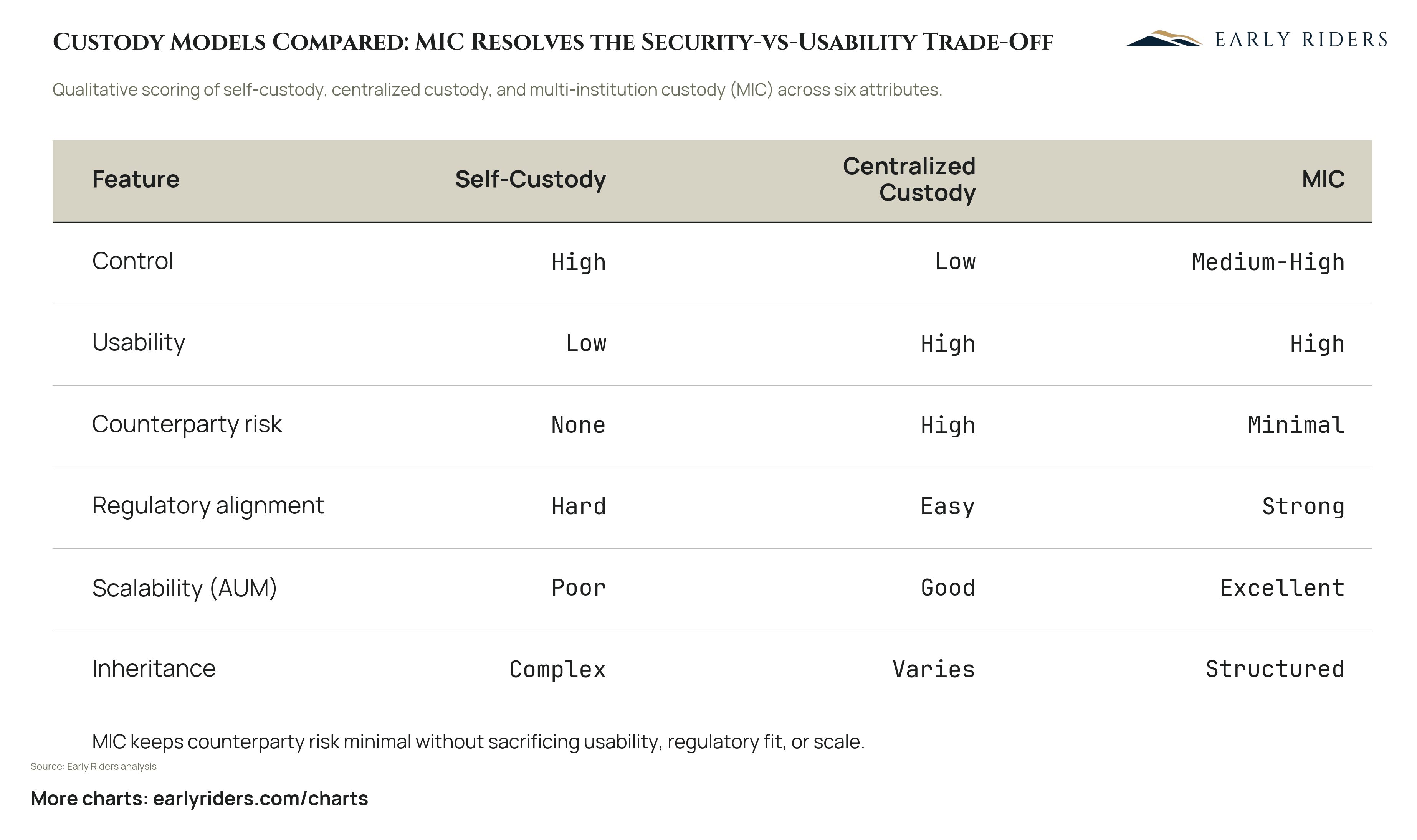
Scored across six attributes, multi-institution custody holds counterparty risk to minimal while matching centralized custody on usability and scale, a combination neither self-custody nor a single custodian achieves.
The comparison scores three ways of holding Bitcoin across six attributes that matter to large holders. Self-custody delivers high control and no counterparty risk, and pays for it everywhere else: usability is low, regulatory alignment is hard, scalability at size is poor, and inheritance is complex. Centralized custody inverts the trade. Usability is high, regulatory alignment is easy, and scale is good, but control is low and counterparty risk is high, which is the exposure that has repeatedly destroyed balances in this asset class. Multi-institution custody, which spreads key control across independent institutions so no single party can move funds alone, scores medium to high on control and minimal on counterparty risk while matching centralized custody on usability. It rates strong on regulatory alignment, excellent on scalability, and structured on inheritance. It is the only column without a weak entry in any row. The ratings are qualitative Early Riders analysis rather than measured values, so the useful output is the shape of the trade rather than any single rating. Most serious holders have already made this decision implicitly, usually by defaulting to whichever pole they encountered first. The table argues the choice is no longer binary. If a structure can hold counterparty risk near zero without forcing you to run your own operational security or leave heirs a puzzle, then treating security and usability as opposites becomes a choice rather than a constraint.
What is multi-institution custody and how does it compare to self-custody?
Multi-institution custody spreads key control across independent institutions. Scored across control, usability, counterparty risk, regulatory alignment, scalability, and inheritance, it rates minimal counterparty risk alongside high usability and excellent scalability. Self-custody carries no counterparty risk but low usability and poor scale, while centralized custody carries high counterparty risk.
Chart data: Qualitative scoring of self-custody, centralized custody, and multi-institution custody (MIC) across six attributes.
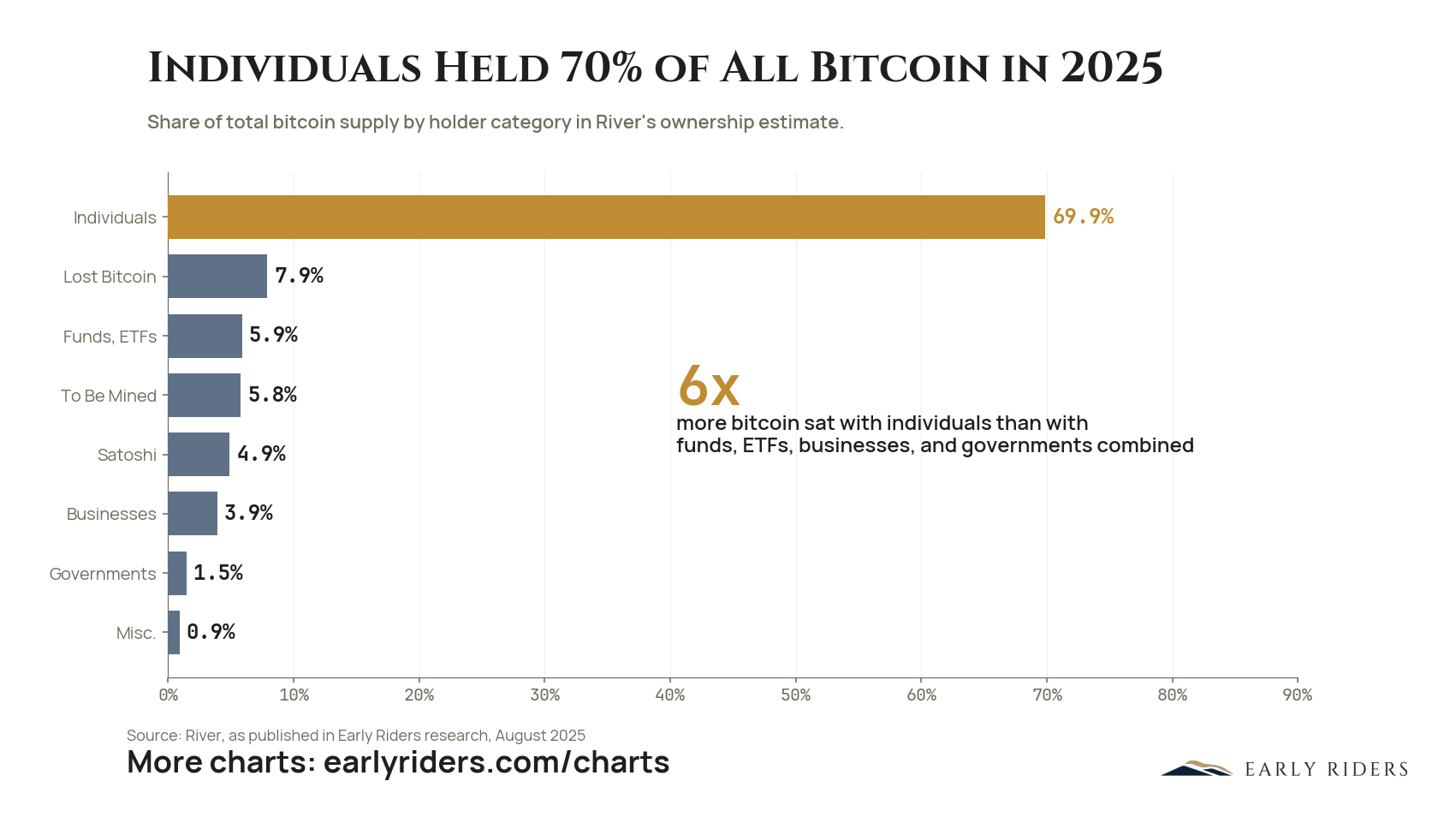
River's 2025 ownership estimate puts 69.9% of all bitcoin in the hands of individuals, about six times what funds, ETFs, businesses and governments hold together.
River estimates that individuals held 69.9% of total bitcoin supply in 2025. Every other category is a rounding error next to it. Lost coins account for 7.9%, funds and ETFs 5.9%, coins yet to be mined 5.8%, Satoshi's holdings 4.9%, businesses 3.9%, governments 1.5% and miscellaneous 0.9%. Add funds, ETFs, businesses and governments together and you get 11.3%, roughly one sixth of what individuals hold. This is an estimate rather than an audited register, since on-chain ownership can only be inferred, and the figures are River's work as published in Early Riders research in August 2025. The distribution matters because the story told about the last cycle was institutional adoption, and the ledger does not support it. Funds and ETFs, for all the flows, control less bitcoin than has simply been lost. That has consequences for anyone building or buying custody. The demand is not concentrated in a handful of large accounts that a single prime broker can serve. It sits with millions of individuals who need infrastructure built for their scale and their inheritance problems. Any service designed on the assumption that institutions are where the assets are is aimed at the smaller half of the market.
What percentage of bitcoin is owned by individuals versus institutions?
Individuals held 69.9% of total bitcoin supply in 2025, according to River's ownership estimate. Funds and ETFs held 5.9%, businesses 3.9% and governments 1.5%, so individuals held about six times the combined institutional total. Lost coins accounted for another 7.9% of supply.
Chart data: Share of total bitcoin supply by holder category in River's ownership estimate.
Period
2025
Plotted
Individuals, Lost Bitcoin, Funds and ETFs, To Be Mined, Satoshi, Businesses, Governments, Misc.
Source
River, as published in Early Riders research, August 2025
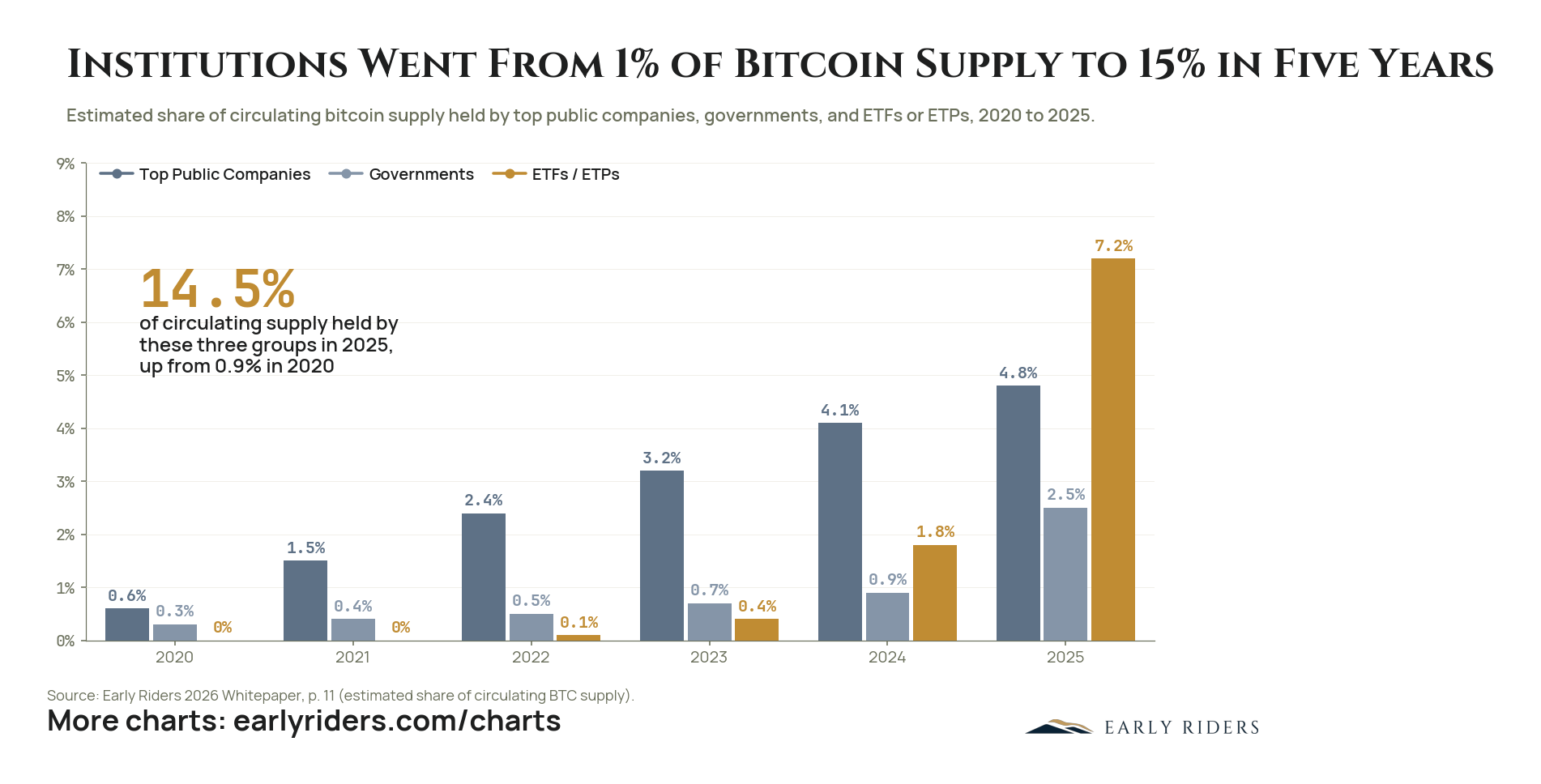
Public companies, governments and exchange-traded funds together held 0.9% of circulating bitcoin in 2020 and 14.5% by 2025, a sixteenfold increase in five years.
In 2020, the three largest categories of institutional bitcoin holders controlled 0.9% of circulating supply between them. By 2025 that figure was 14.5%. Exchange-traded funds and exchange-traded products account for the largest single share at 7.2%, which is striking given they held nothing at all in 2020 and 2021 and did not exist in US spot form until January 2024. Publicly listed companies hold 4.8%. Governments hold 2.5%, most of it acquired through seizure rather than purchase.
What changed is not just the quantity but the character of the holder. These are balance sheets and fund structures with reporting obligations, board oversight and, in the case of the funds, a creation and redemption process that converts retail savings flows directly into spot demand. They are slower to sell than the trading accounts that dominated the previous cycle, and in the case of government holdings, frequently prohibited from selling at all for long stretches.
Roughly one bitcoin in seven now sits in a structure that does not respond to a 30% drawdown the way a leveraged trader does. The float that actually clears the market is smaller than the circulating supply figure suggests, and it has been shrinking for five consecutive years.
What percentage of bitcoin supply is held by institutions, ETFs and governments?
Institutions held 14.5% of circulating bitcoin supply in 2025, up from 0.9% in 2020. That breaks down as 7.2% in ETFs and ETPs, 4.8% at top publicly listed companies, and 2.5% held by governments, a roughly sixteenfold increase over five years.
Chart data: Estimated share of circulating bitcoin supply held by top public companies, governments, and ETFs or ETPs, 2020 to 2025.
Period
2020 through 2025
Source
Early Riders 2026 Whitepaper, p. 11 (estimated share of circulating BTC supply).
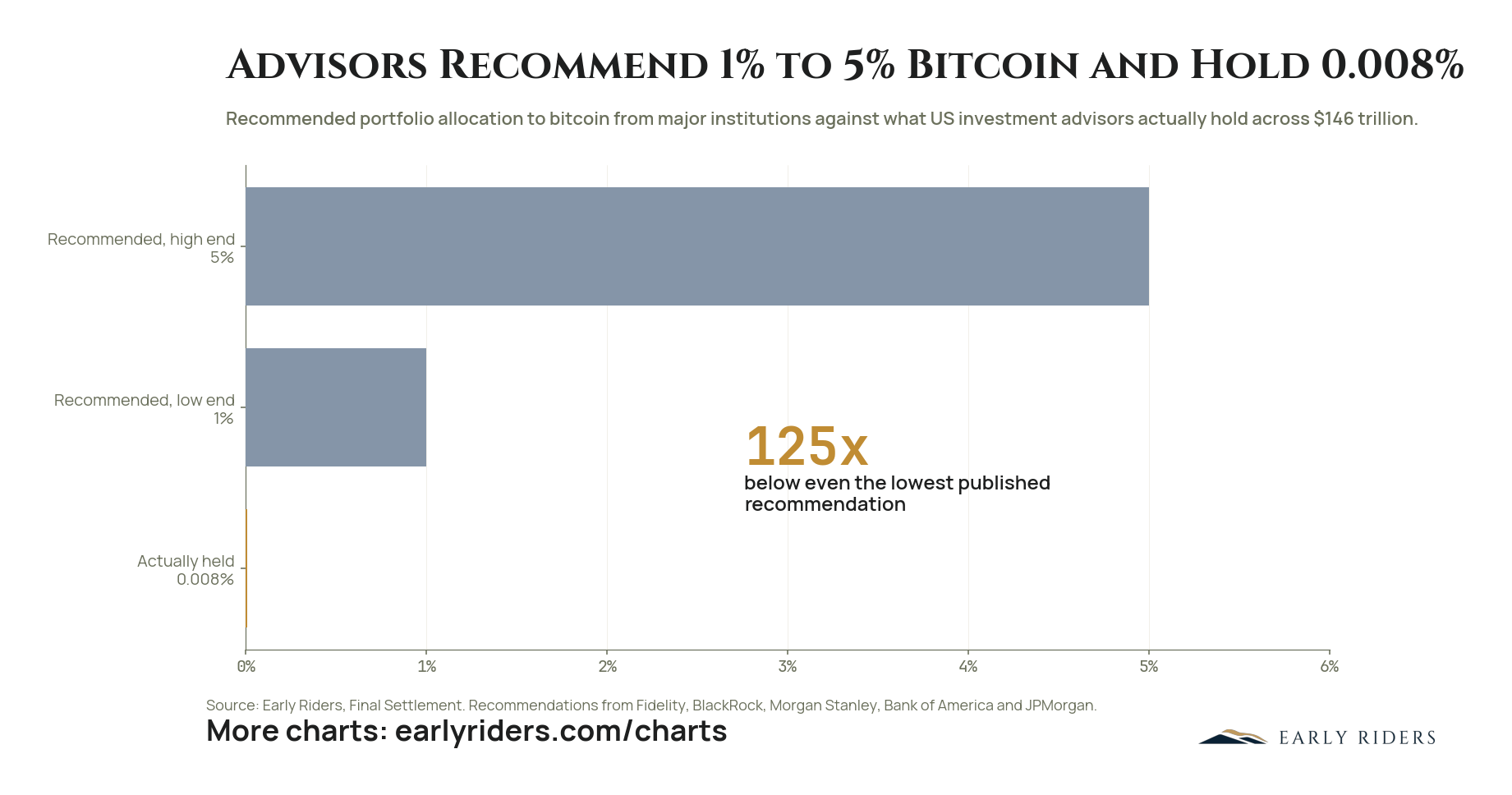
Five major institutions publish bitcoin guidance of 1% to 5%, while actual holdings across $146 trillion of US advisor assets sit at 0.008%.
US investment advisors oversee roughly $146 trillion. Fidelity, BlackRock, Morgan Stanley, Bank of America and JPMorgan have all published guidance recommending a bitcoin position of 1% to 5%. Actual advisor holdings sit at 0.008%, between 125 and 625 times below the range their own research departments recommend.
The third bar is not missing from the chart. It is drawn at 0.008% and is too small to see at a scale where 5% fits, which is a fair visual account of the situation.
The gap matters most for what it is not. This is not a case of institutions examining bitcoin and declining to hold it, which would be a considered judgment worth respecting. The firms publishing the recommendations are the same ones whose advisors have not acted on them. The distance between the two numbers measures operational friction rather than conviction: platform approvals, inclusion in model portfolios, compliance sign-off, custody arrangements, and the ordinary inertia of an advisory business that changes positions slowly.
That is the argument for treating market structure as the binding constraint rather than persuasion. Closing even part of this gap requires the plumbing to exist first, which is why custody arrangements and platform access set the pace far more than sentiment does. One percent of $146 trillion is $1.5 trillion.
What percentage of advisor assets is actually allocated to bitcoin?
About 0.008% of the roughly $146 trillion held by US investment advisors. Fidelity, BlackRock, Morgan Stanley, Bank of America and JPMorgan all publish guidance recommending 1% to 5%, which puts actual holdings between 125 and 625 times below the recommended range.
Chart data: Recommended portfolio allocation to bitcoin from major institutions against actual holdings across $146 trillion of US investment advisor assets.
Period
2026
Plotted
Recommended high end, Recommended low end, Actually held
Source
Early Riders, Final Settlement. Recommendations from Fidelity, BlackRock, Morgan Stanley, Bank of America and JPMorgan.
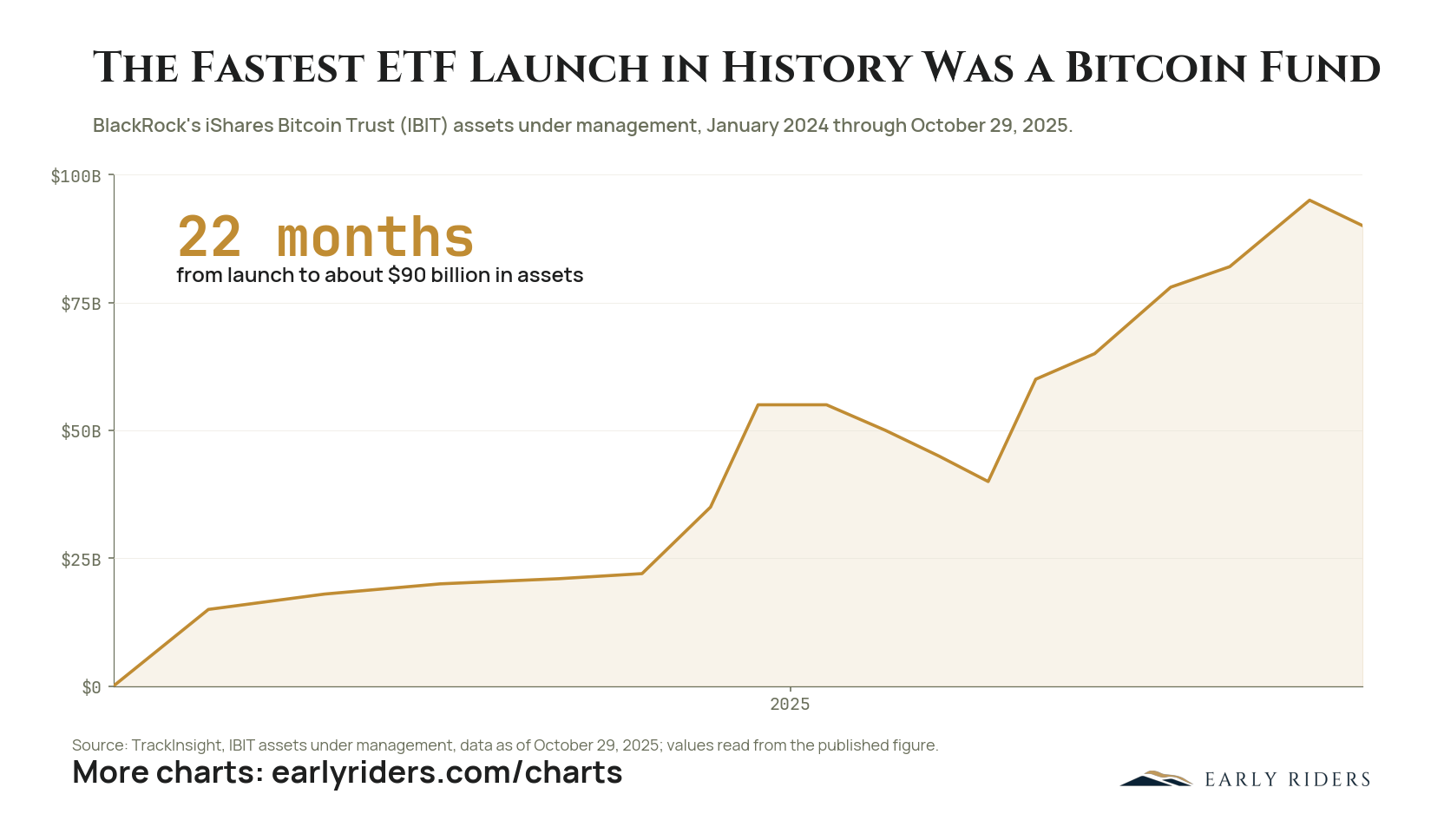
BlackRock's iShares Bitcoin Trust went from zero to about $90 billion in assets in the 22 months after it began trading in January 2024, the fastest asset gathering any exchange-traded fund has ever done.
The iShares Bitcoin Trust started trading on January 11, 2024 with no assets. Within months it was holding between $18 billion and $22 billion, a level it sat at through the middle of 2024. By December 2024 it had stepped up to $55 billion. Assets then fell back to about $40 billion in April 2025, since a fund's asset base moves with price as well as with flows, before climbing to roughly $95 billion at the start of October 2025. On October 29, 2025 it stood at $90 billion, 22 months after launch. No other exchange-traded fund has gathered assets on that schedule.
The number matters less as a milestone than as evidence about who is buying. A fund that size is not built by a handful of large tickets. It is built by continuous, mechanical demand arriving through ordinary brokerage accounts, retirement platforms and model portfolios that could not touch the asset at all before 2024. That demand does not negotiate on price and it does not stop when the spot market is quiet.
The access question is now settled. The question worth sitting with is what a permanent, price-insensitive bid does to a supply schedule that cannot expand to meet it.
How fast did BlackRock's bitcoin ETF (IBIT) reach $90 billion in assets?
IBIT reached about $90 billion in assets by October 29, 2025, roughly 22 months after it began trading on January 11, 2024. It crossed $55 billion by December 2024, dipped to about $40 billion in April 2025, and peaked near $95 billion in early October 2025.
Chart data: BlackRock's iShares Bitcoin Trust (IBIT) assets under management, January 2024 through October 29, 2025.
Period
January 2024 through October 2025
Source
TrackInsight, IBIT assets under management, data as of October 29, 2025; values read from the published figure.
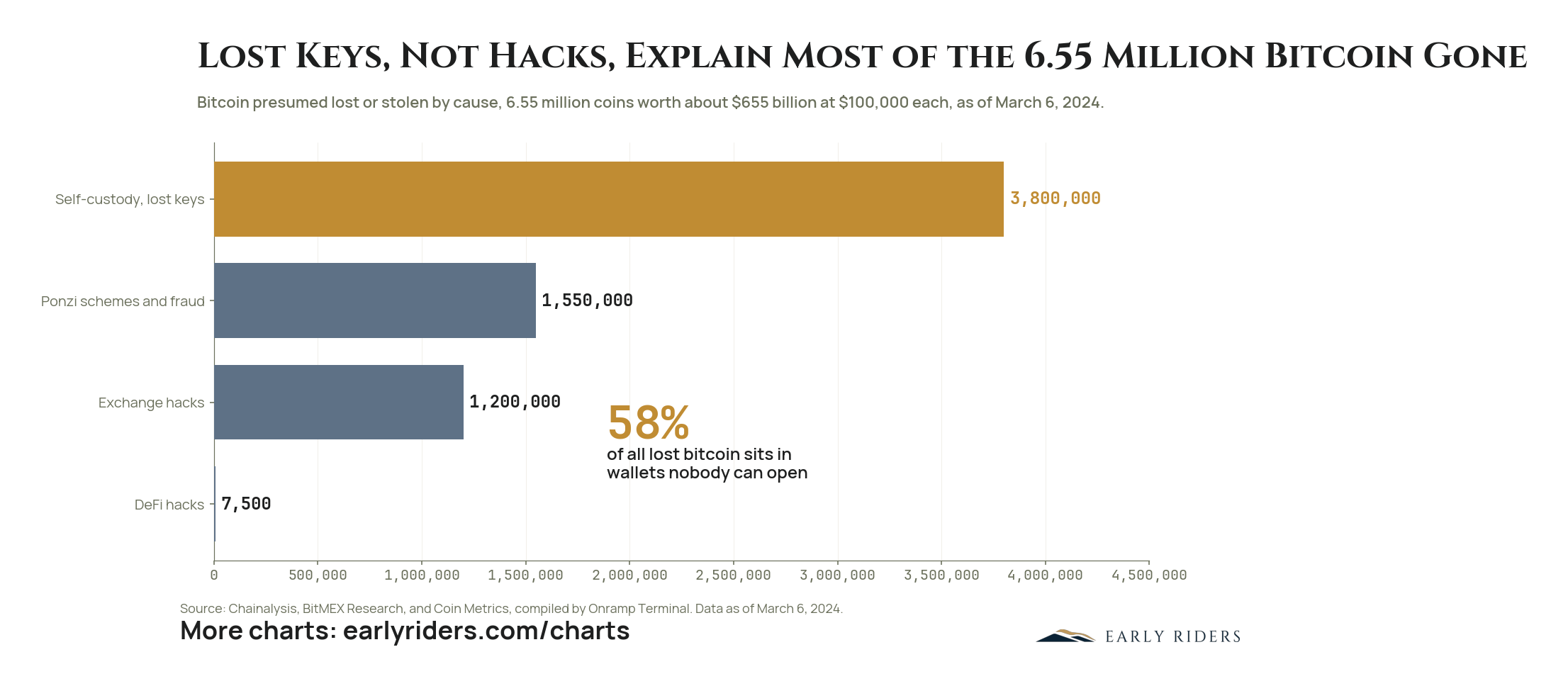
Of the 6.55 million bitcoin that are permanently gone, 3.8 million were lost by their own owners to forgotten keys, more than the losses from exchange hacks, fraud and DeFi exploits combined.
About 6.56 million bitcoin are unrecoverable. The largest category by a wide margin is self-custody failure: 3.8 million coins, or 58% of the total, sitting in wallets whose keys no longer exist. Ponzi schemes and outright fraud account for 1.55 million. Exchange hacks, the category that generates almost all of the headlines, account for 1.2 million. DeFi exploits account for 7,500, which is a rounding error at this scale. Priced at $100,000 per coin, the full 6.56 million represents about $655 billion.
The ranking inverts the usual anxiety. The dominant risk to a long-term holder is not a sophisticated attacker or an exchange collapse. It is a hard drive in a drawer, a seed phrase written once and stored badly, or an owner who dies without leaving a recoverable path to the keys. Those failures are quiet, individual, and almost never reported, which is precisely why they compound to a larger number than every publicised theft combined.
The practical consequence is that custody design deserves as much attention as position sizing. Key redundancy, geographic separation of backups, and a documented inheritance process are the difference between owning bitcoin and having owned it.
How many bitcoin are lost forever and what is the main cause?
About 6.55 million bitcoin are permanently lost. The largest cause is self-custody failure, with 3.8 million coins, or 58%, in wallets whose keys are gone. Ponzi schemes and fraud account for 1.55 million, exchange hacks 1.2 million, and DeFi hacks 7,500. At $100,000 per coin that is roughly $655 billion.
Chart data: Bitcoin presumed lost or stolen by cause, 6.55 million coins worth about $655 billion at $100,000 each, as of March 6, 2024.
Source
Chainalysis, BitMEX Research, and Coin Metrics, compiled by Onramp Terminal. Data as of March 6, 2024.
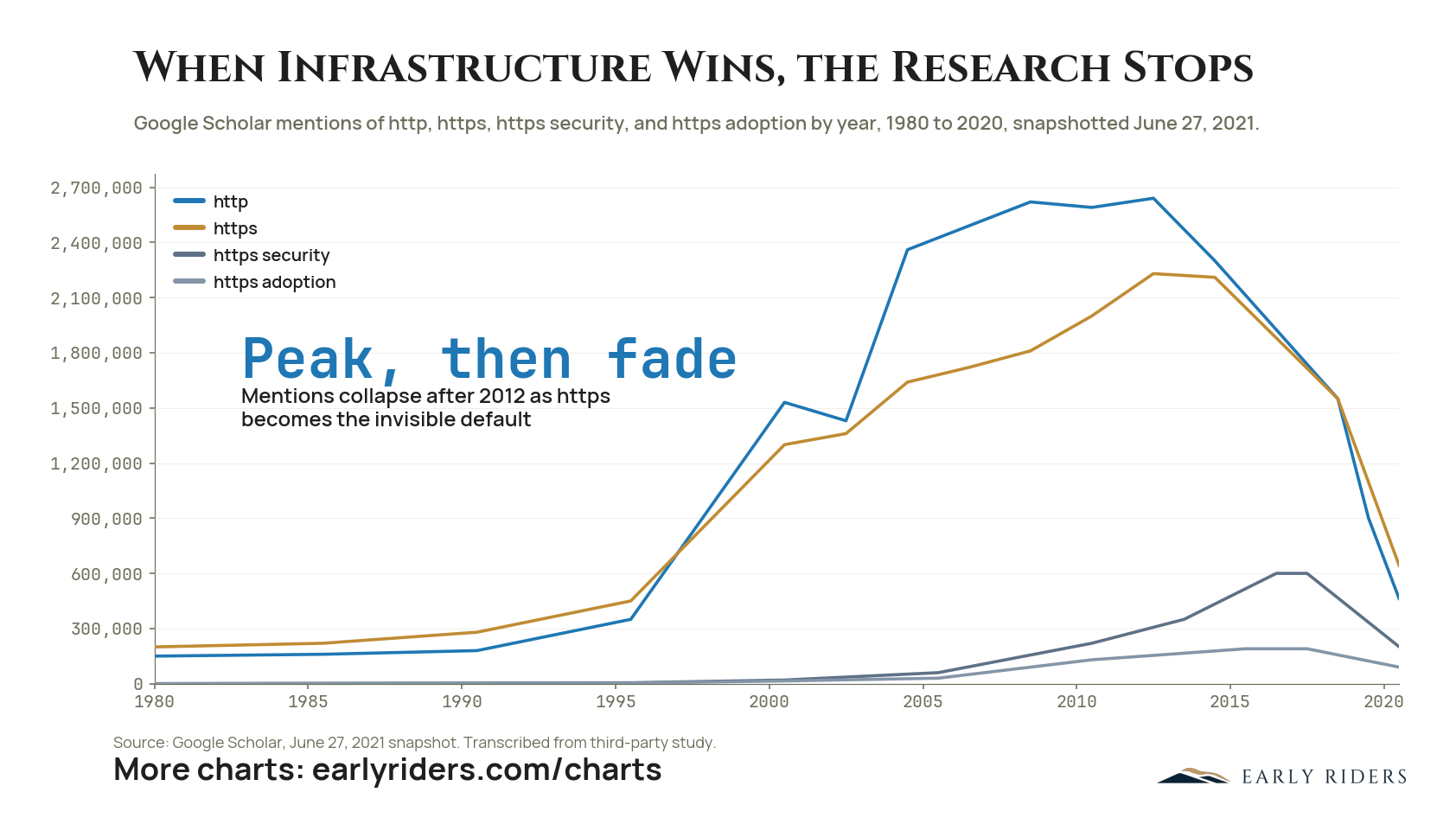
Academic attention to http and https peaked in the early 2010s and then fell by roughly three quarters, because infrastructure only commands scrutiny while its outcome is still in doubt, and bitcoin custody has not reached that point yet.
Google Scholar mentions of http climbed from about 150,000 a year in 1980 to more than 2.6 million around 2012. Mentions of https crested near 2.2 million in 2014. Both then fell to roughly a quarter of their peaks by 2020, with http running under 500,000 and https near 600,000.
Nothing in that decline reflects failure. Early online commerce asked ordinary people to understand encryption, inspect certificates, and judge for themselves whether a payment page was safe, and most of them simply refused to enter card details at all. SSL solved the trust problem by making the cryptography invisible: a padlock icon and a protocol prefix replaced any need to understand the mechanism underneath. Once that worked, the question was settled and the research moved on. Infrastructure earns scrutiny while its outcome is contested, and loses it once it wins.
This is the pattern the parent article traces through personal computers, the iPhone, and SSL: a hobbyist era that demands real expertise, then institutional-grade infrastructure that hides the complexity, then mass adoption. Bitcoin custody is still in the first phase. Self-custody today asks of holders exactly what early e-commerce asked of shoppers, namely key management, operational security, and disaster recovery, with no forgiveness for a mistake. Multi-institution custody is the equivalent second-phase move, distributing trust across independent institutions while preserving on-chain verifiability and removing the single points of failure that centralized custody creates. The signal that it has worked will not be enthusiasm. It will be the moment the argument goes quiet.
When did academic interest in HTTP and HTTPS peak?
Google Scholar mentions of http peaked above 2.6 million a year around 2012 and https near 2.2 million in 2014, then both fell to roughly a quarter of those levels by 2020. The counts come from a June 27, 2021 snapshot transcribed from a third-party study. Attention faded as encryption became the web's default.
Chart data: Google Scholar mentions of http, https, https security, and https adoption by year, 1980 to 2020, snapshotted June 27, 2021.
Period
1980 to 2020
Plotted
http, https, https security, https adoption
Source
Google Scholar, June 27, 2021 snapshot. Transcribed from third-party study.
Get Open Range, the weekly Early Riders letter on Bitcoin, AI, and digital asset markets — a front-row seat to the singularity, delivered directly to your inbox.