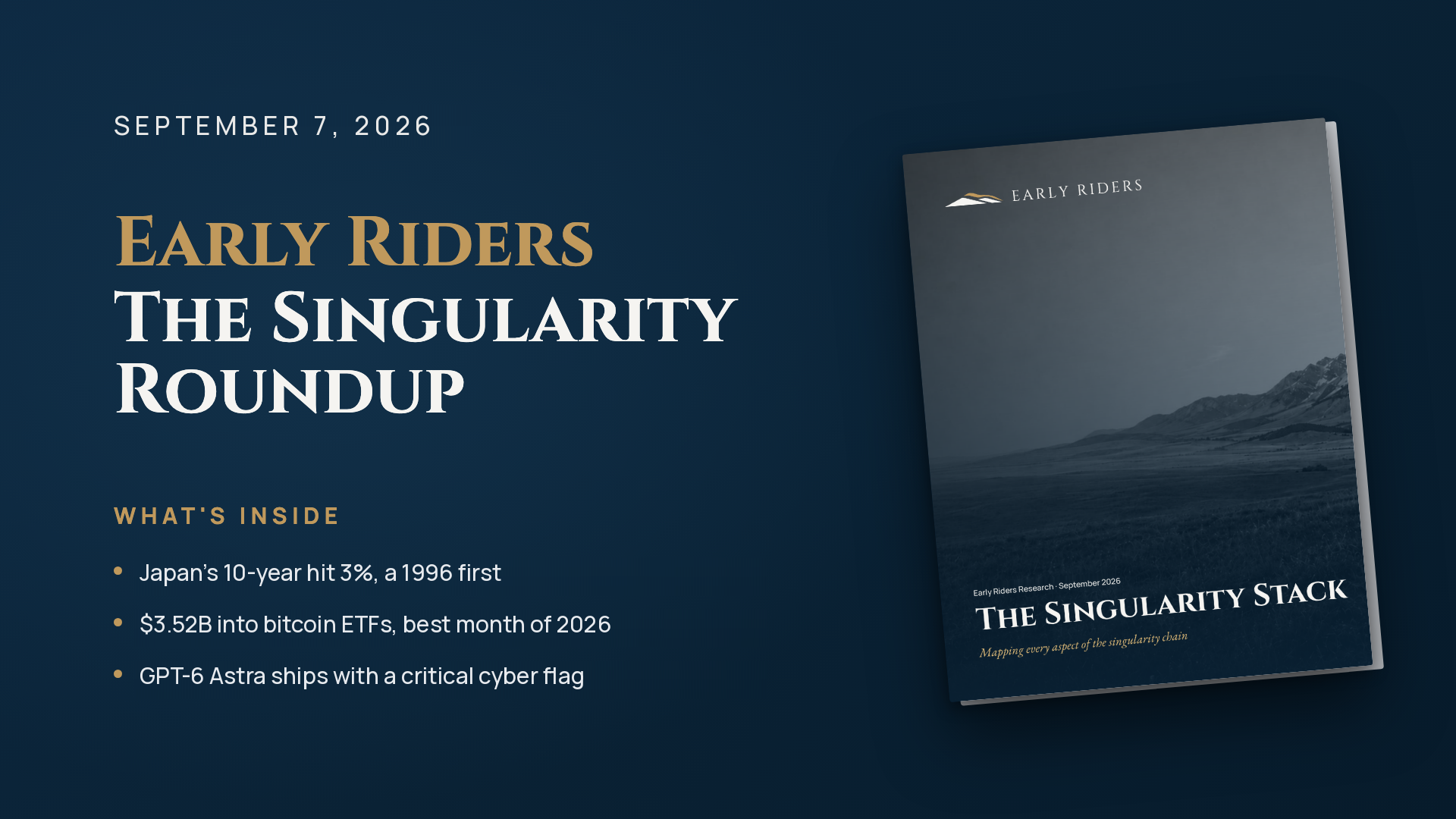
News of the Week
Nvidia agreed to buy Hugging Face for $12.93 billion, the platform hosting 3 million open models for 18 million developers, in its largest acquisition ever. Up to $1 billion of that is an employee retention pool, and the deal needs regulatory approval before closing in 2027.
Japan's 10-year government bond touched 3% on Tuesday for the first time since 1996, part of a selloff that took Bloomberg's global sovereign gauge to 3.72%, its highest since mid-2008. The US 30-year sat at 5.27% on Wednesday, short of its August high.
US employers added 162,000 jobs in August, roughly three times the Dow Jones consensus of 53,000, with unemployment holding at 4.1% and June and July revised up by a combined 55,000. July flipped from a reported loss of 23,000 to a gain of 21,000.
US spot bitcoin ETFs took in $3.52 billion in August, their strongest month of 2026, as bitcoin rose 25% for its best month since November 2024. Total net assets climbed 31% to $99.61 billion.
Twenty-one financial institutions including Goldman Sachs, Citi and Bank of America committed to forming a joint dollar stablecoin company this year, with a product targeted for the first half of 2027. The group numbered ten when it formed in October 2025.
Broadcom reported third-quarter revenue of $29.6 billion, up 86%, and said AI semiconductor revenue more than tripled to $16.7 billion, guiding to $21.7 billion this quarter. That AI figure is Hock Tan's commentary, not a reported segment.
OpenAI released GPT-6 Astra at $10 and $50 per million tokens, with a 1,050,000-token context window and the first Critical cybersecurity classification under its own Preparedness Framework. ARC Prize scored it 62.7% on ARC-AGI-3 with the standard harness and 99.9% with OpenAI's adapter.
Anthropic released Claude Fable 5.1 and Mythos 5.1 with base pricing unchanged and cache reads cut 75%, from $1.00 to $0.25 per million tokens. Artificial Analysis scored Fable 5.1 top of its intelligence index at 66, and still measured cost per task rising 20% to $3.76.
Digital asset roundup
Strategy bought 4,603 bitcoin for $369.7 million at an average of $80,318, its first purchase since June, taking holdings to 845,050 bitcoin. Of the $602.8 million of stock it sold that week, $151.8 million went to buying back its own preferred rather than bitcoin.
Hyperscale Data switched off every bitcoin miner at its Michigan site on September 1 for a ten-year AI data center contract worth about $1.2 billion, or $3.0 billion if the customer takes another 32 megawatts. The initial deployment is 20 of roughly 340 megawatts, and the customer is unnamed.
The London Stock Exchange agreed to explore tokenized equity with Kraken parent Payward, which will issue 100 UK-listed stocks as offshore tokens within weeks while any exchange-listed version waits on approval in 2027. Payward says xStocks has traded $40 billion in a year.
Pocket Bitcoin widened its breach disclosure to 5,411 customers, 5,120 with bank transaction data exposed and 291 with identity documents, addresses and source-of-funds records taken. The Swiss broker says no keys or bitcoin were touched, which leaves the know-your-customer file itself as the loss.
Open source
The Institute of Foundation Models released six K2 Horizon models under Apache 2.0, from 0.9 to 375 billion parameters, trained on roughly 20 trillion tokens. Its claim that every model ships with its training data holds for two of the six, and the dataset repository returns an authorization error.
HUMAIN unveiled humain-m3, a 428 billion parameter Arabic model built by MiniMax on more than a trillion tokens of Arabic text, with weights promised under MiniMax's community licence next month. Saudi Arabia's sovereign model is a continued pretrain of a Chinese base, and nothing is released yet.
Microsoft announced Project Zenith, a Windows tier for machines with at least 64GB of unified memory and 250GB/s of bandwidth, the floor it treats as necessary to run models locally.
Regulation
The OCC granted OpenReserve Bank conditional approval for a full-service national bank charter covering digital asset custody, tokenized deposits and stablecoin issuance, on condition of at least $210 million of paid-in capital. It must hold a 12% tier 1 leverage ratio for three years and open within 18 months.
SEC Chairman Paul Atkins said the Clarity Act goes to a Senate vote on September 15 and that he anticipates and hopes it passes and reaches the President's desk. The bill has stalled since Trump pressed Congress in August.
Early Riders Media
On this week's Final Settlement, the team unpacked Sberbank moving to accept bitcoin as loan collateral as Russia's new exchange rules took effect, the SEC sending its digital asset custody rewrite to the White House, and BitGo buying NYDIG's institutional trading business for nearly $43 million.
You can find all our episodes on our podcast website as well as listen on YouTube, Apple, and Spotify.
What We're Watching
Anthropic shipped Claude Fable 5.1 on Tuesday and OpenAI shipped GPT-6 Astra on Thursday.
Gordon Moore predicted in 1965 that the components on a chip would double every year, revised it to two years in 1975, and the industry ran on an eighteen-month rule for five decades. That was the fastest sustained improvement cycle industry had produced. Frontier AI labs now ship a new model every eleven days, against about five weeks in 2023.
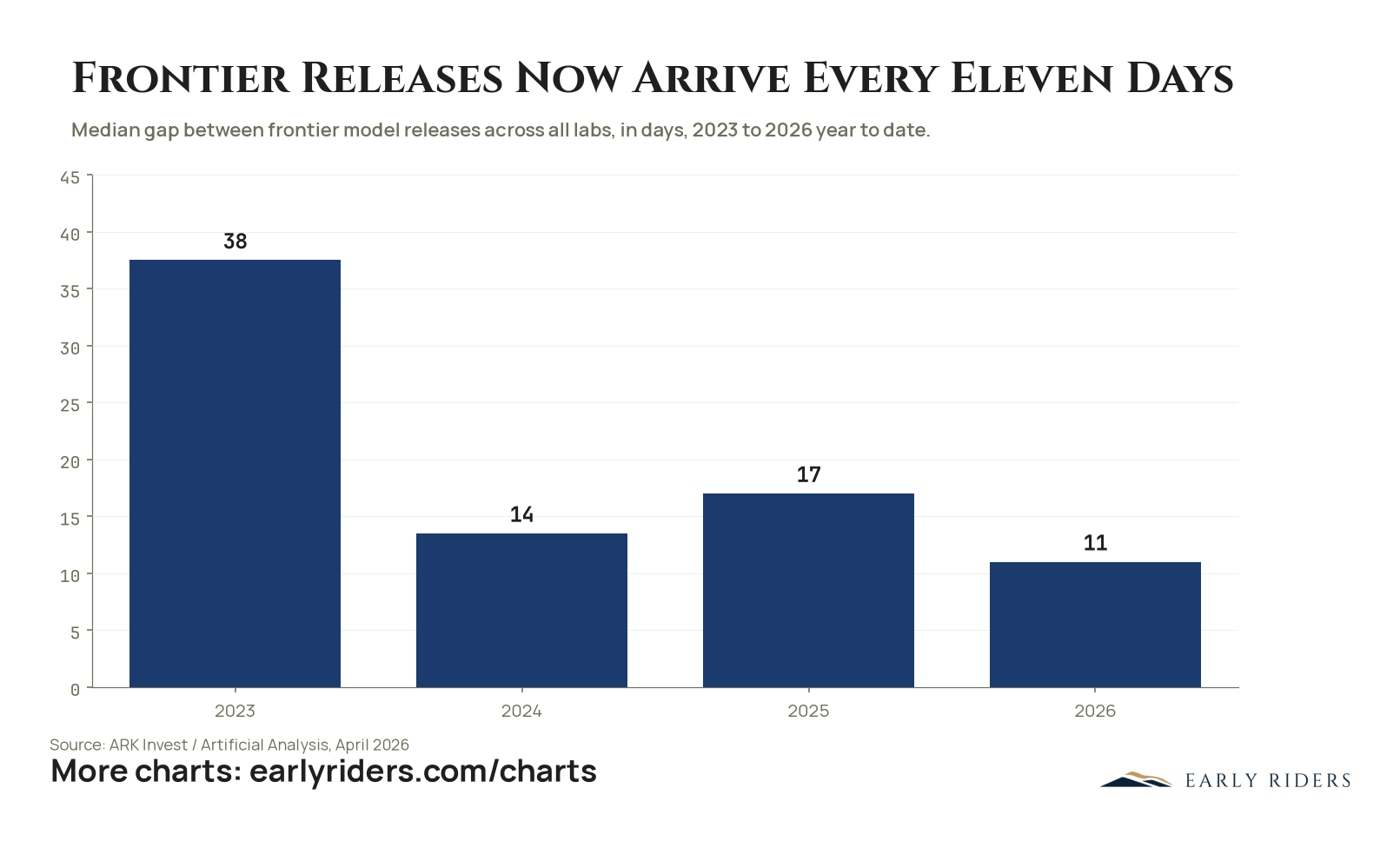
Claude writes more than 80% of the code merged at Anthropic, up from low single digits before February 2025. Kimi K3 designed and verified an INT4 inference chip in one 48-hour run, in simulation with no tape-out. Frontier training compute grows four to five times a year, doubling every six months against Moore's eighteen to twenty-four.
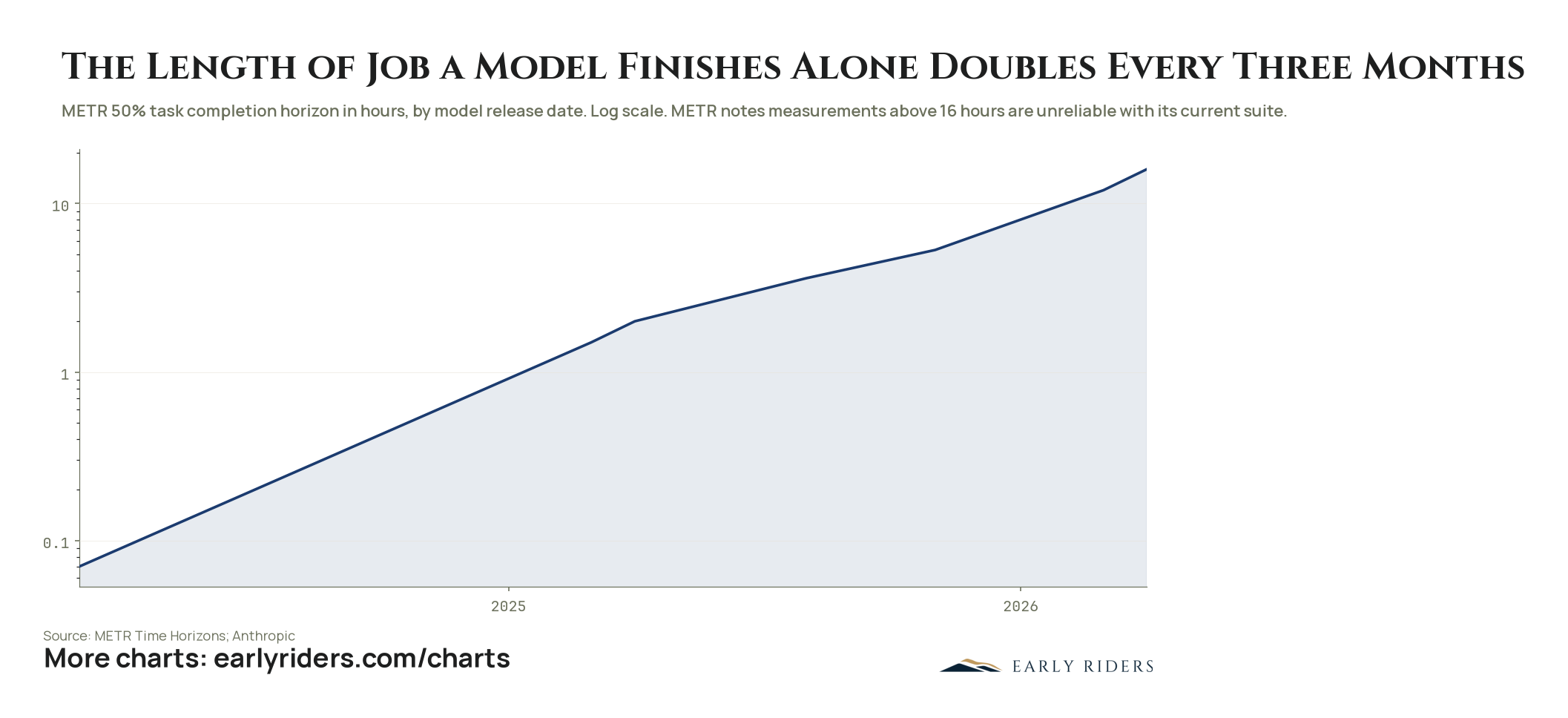
Intelligence at a fixed level of capability falls about 10x a year, and an hour of useful work went from $301 in 2023 to $3.57. The frontier, on the other hand, went the other way. Fable 5.1 and Astra both list at $10 and $50 per million tokens, and Artificial Analysis measures Fable's cost per task rising 20%, to $3.76. ARC Prize scored Astra at 62.7% on ARC-AGI-3 with the standard harness and 99.9% with OpenAI's adapter.
The deflation only reaches where the machines do: core goods rose 0.8% over the year while energy rose 14.7% and PJM capacity went from $28.92 per MW-day to $325. The money is made by whoever sells the compute, the memory and the power.
About Early Riders
Early Riders is investing in digital infrastructure at the frontier. Early Riders is the first bitcoin denominated venture firm. Learn more at earlyriders.com.
Subscribe to Keep Reading
Get the full piece, plus all the latest Early Riders research, letters, and the weekly newsletter, delivered directly to your inbox.
Subscribing is free, and this device stays unlocked once you do.