
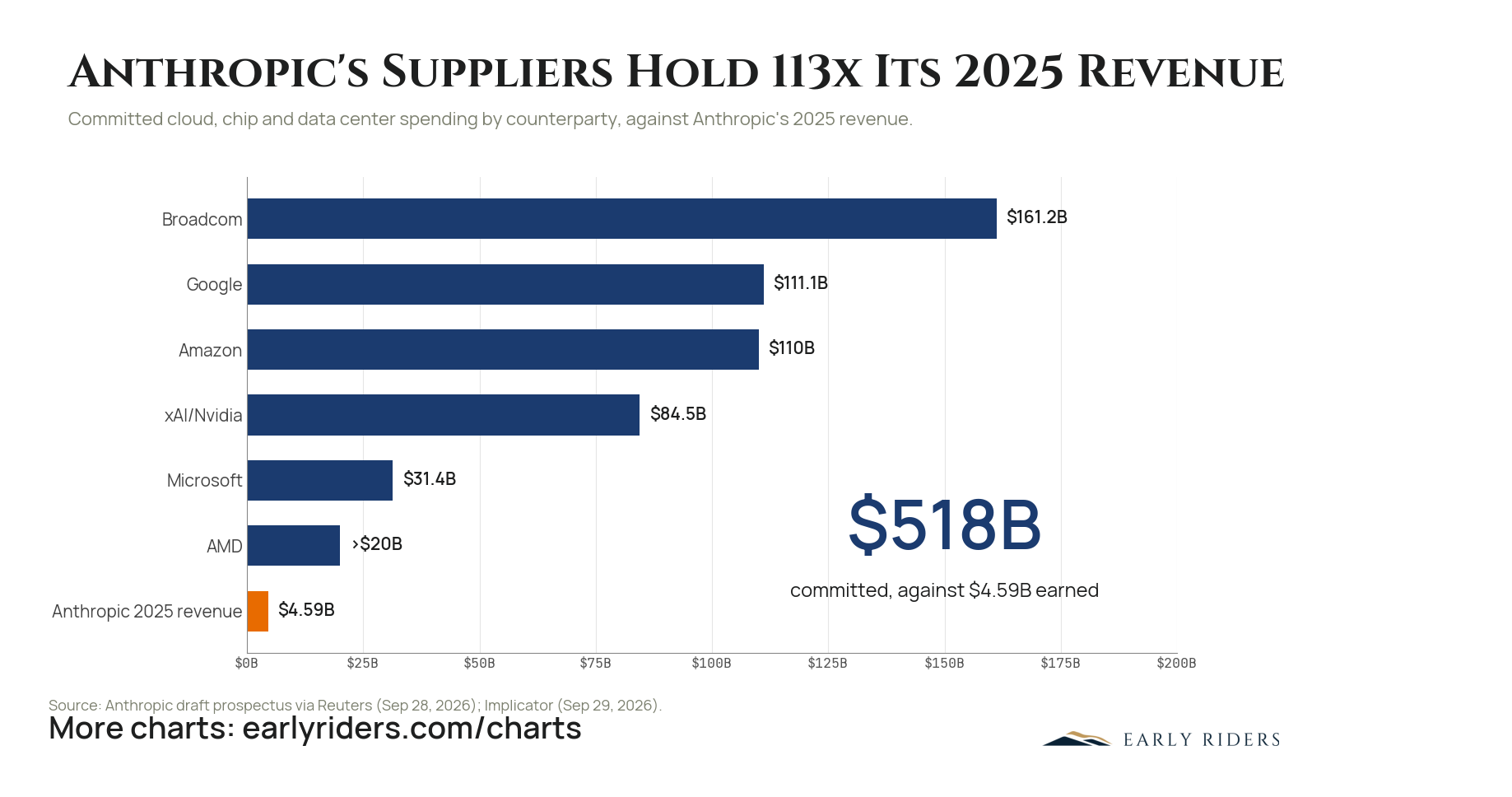
Anthropic has promised its suppliers $518 billion. The draft prospectus Reuters reported on Monday sets that against $4.6 billion of revenue in 2025, about 113 times what the company took in. The largest line goes to Broadcom at about $161 billion, followed by Google at $111 billion and Amazon at $110 billion, and roughly 80% of the total cannot be canceled.
The other side of those contracts is already being paid. Micron reported $54.2 billion of revenue for its latest quarter on Wednesday, nearly 12 times Anthropic's full year, and kept 80.7% of its fiscal 2026 sales as gross profit. Nvidia added $150 billion to its share buyback, the largest increase in its history.
Anthropic's revenue reached $11.5 billion in the second quarter of 2026 alone, with positive adjusted operating income, and at that pace, the obligations equate to nearly 11 years of sales. For comparison, many telecom carriers made a similar bet between 1996 and 2001, putting more than $500 billion into networks, and by 2002 no more than 2% of North America's long-distance fiber was in use. For now, the gains sit with whoever sells the chips, the memory and the cloud capacity. Those firms collect in cash today, while Anthropic carries contracts that run to 2036.
News of the Week
Anthropic's draft IPO prospectus showed a $42 billion net loss for 2025, about $34 billion of it a non-cash charge tied to earlier fundraising, and $20.28 billion in cash, Reuters reported. The listing, expected after the midterms, targets a valuation above $2 trillion.
US employers added 29,000 jobs in September against a Dow Jones consensus of 84,000, unemployment rose to 4.2% from an expected 4.1%, and Treasury yields tumbled on the report.
Bitcoin gained about 40% in the third quarter, its best quarter since late 2024, reaching roughly $83,700. Citi raised its 12-month target to $113,000 from $82,000, counting on $5 billion of new ETF inflows.
OpenAI is in talks to raise at least $30 billion at a roughly $1.4 trillion valuation, up from $852 billion in March, on a $40 billion revenue run rate in August.
ElevenLabs doubled its valuation to $22 billion from $11 billion in February through a $300 million employee tender offer led by Wellington and T. Rowe Price. The tender let employees sell part of their vested shares to investors.
Tavus said 48% of people who held a one-minute video call with its new Griffin-Lite model believed it was a real person, compared to only 2.4% reported for comparable models.
Digital asset roundup
Strategy bought 1,665 bitcoin for $142.7 million at about $85,681 each, lifting its holdings to a record 847,666 bitcoin acquired for $63.95 billion, funded by selling 1.47 million shares.
Citi tapped Coinbase for the rails that let its institutional clients accept stablecoin payments at checkout, with Citi settling the funds. Coinbase payments customers can hold stablecoins at Coinbase that earn a reward, currently 3.75% a year.
Morgan Stanley opened a Digital Asset Lab to test stablecoins, tokenization and decentralized finance inside its innovation labs, which cover 20,000 square feet across cities including New York, Glasgow and Bangalore and run up to 270 projects a year.
Coinbase won CFTC registration for its own clearinghouse, so it now runs the exchange, broker and clearing layers for fully collateralized derivatives, with USDC as collateral.
Coinbase denied Ari Paul's allegation that it concealed more than $1 billion of hack losses at a dozen or more firms, including $25 million from his BlockTower.
Open source
Nvidia released Kumo Tabular, open-weight models from 28 million to 215 million parameters under OpenMDW-1.1 that predict on spreadsheet data with no training, and ranks first on the TabArena leaderboard with an Elo of 1,950.
AWS released Strands Decider 2B, a 2 billion parameter open-weight model that picks from a set of options and scores how sure it is, answering in about 115 milliseconds on an RTX 3090. Its team ranks it third of 33 models in its class.
DeepSeek released open-source libraries built with Huawei for its Ascend chips, including DeepGEMM-Ascend for matrix math in BF16, FP8 and FP4, and tuned them on a supernode of 128 Ascend 950 chips to cut reliance on Nvidia's CUDA.
Regulation
The SEC proposed a digital asset custody framework for investment advisers and funds that lets state trust companies act as custodians and permits self-custody in certain circumstances, with comments open for 60 days after Federal Register publication.
Sen. Steve Daines released the ADAPT Act with three Republican colleagues, exempting network fees of $10 or less per transaction from tax and applying 30-day wash-sale rules to digital assets.
Early Riders Media
Final Settlement: This Chart Exposed the AI Trade and Loves Bitcoin
"AI is just gonna compete away all the profits. And so you're gonna have to think about where do you store that value." - Michael Tanguma, on the falling cost of intelligence.
Watch or listen on YouTube, Apple and Spotify.
Thanks for reading. If someone you know should be reading this, forward it to them.
About Early Riders
Early Riders is investing in digital infrastructure at the frontier. Early Riders is the first bitcoin denominated venture firm. Learn more at earlyriders.com.
Subscribe to Keep Reading
Get the full piece, plus all the latest Early Riders research, letters, and the weekly newsletter, delivered directly to your inbox.
Subscribing is free, and this device stays unlocked once you do.