
Treasury sold $22 billion of 30-year bonds on Thursday at 5.618%, the highest auction yield since 2000, and bidders still asked for 2.54 times the supply. The government pays an average of 3.52% on $31.8 trillion of marketable debt, and $10.6 trillion of it, about a third, comes due within 12 months to be rolled at today's rates.
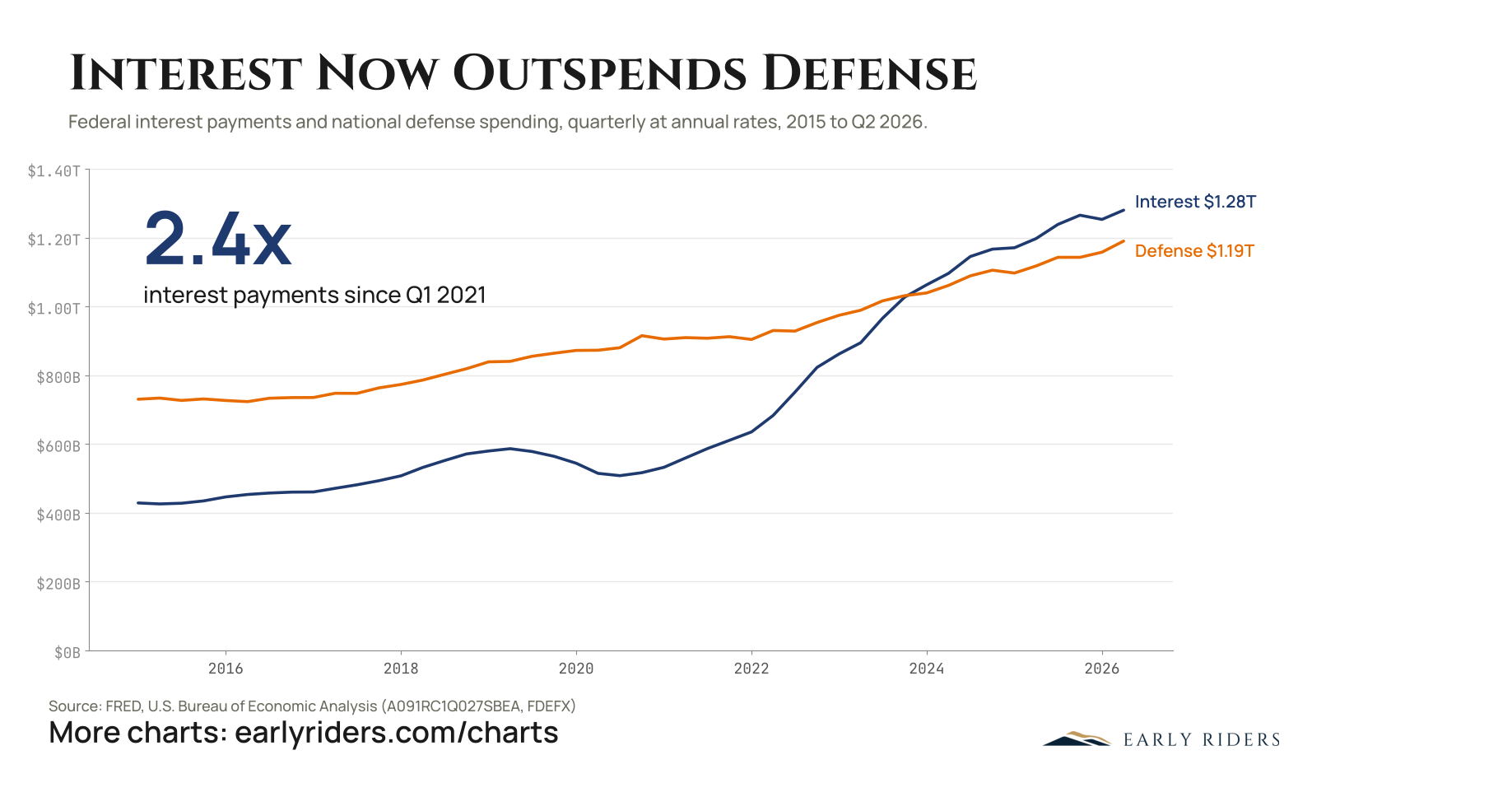
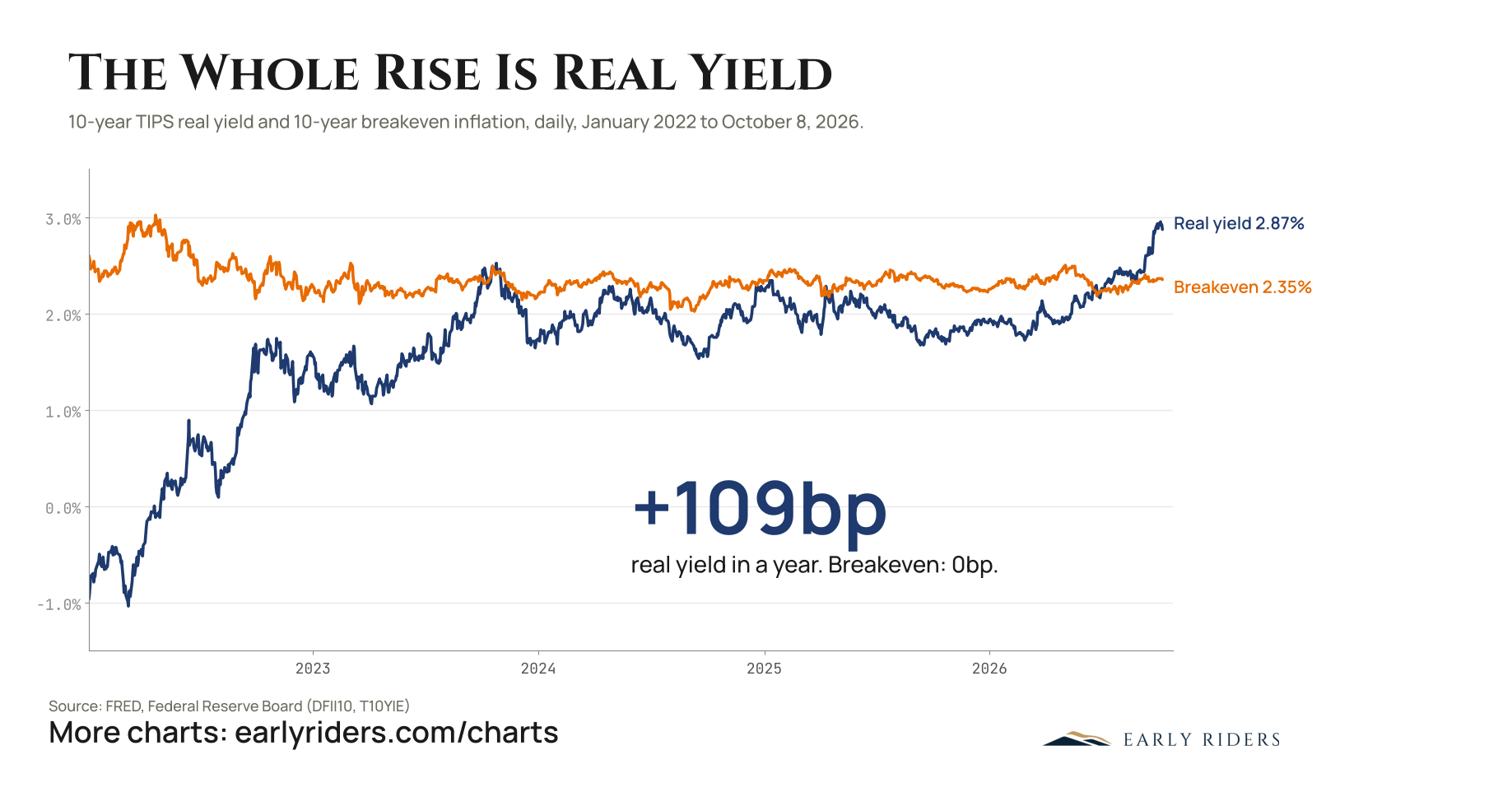
Over the past year the 10-year yield rose 109 basis points, and the 10-year TIPS yield rose the same 109, to 2.87%, while expected inflation held at 2.35%. Lenders want a return above inflation, and they are getting one: interest on the debt will cost $1.14 trillion in fiscal 2026, $227 billion more than the Pentagon, the CBO says.
The President has floated the other way out. Inflation, he told Time, will "pay off that debt very rapidly." It has worked before. Debt held by the public fell from 106% of GDP in 1946 to 23% in 1974, helped by years of interest rates held below inflation. The strongest case against alarm is the demand itself: indirect bidders, the usual proxy for foreign buyers, took 72% of Thursday's sale.
That exit needed lenders with nowhere else to go, and these ones are collecting 2.87% above inflation to stay. For now the gains go to whoever lends at today's rates, paid from a budget that spends 21 cents of every revenue dollar on interest. If Washington takes the inflation route anyway, those lenders pay for it, and the gains move to assets nobody can print more of.
News of the Week
Treasuries sold off on Oct. 7, pushing the 10-year yield to a 24-year peak of 5.364% and the 30-year to its own 24-year high as oil topped $100, with the 10-year auction still drawing a 2.77 bid-to-cover.
Fed minutes showed all 12 voters backed September's hike to 3.75% to 4.00%, and most participants judged another increase likely appropriate by year end. Staff put August PCE inflation at 3.8% and core at 3.4%.
SpaceX sought $40 billion to buy Nvidia chips in talks Bloomberg called preliminary, with the FT reporting about $10 billion of bank loans and $30 billion of investment-grade debt led by Apollo and closing expected in 2027.
DeepSeek neared a round of at least 80 billion yuan backed by Tencent and CATL, while Moonshot AI reached a $50 billion valuation on about $1 billion of recurring revenue and lined up a Hong Kong IPO of up to $5 billion, Bloomberg reported.
Google and Constellation signed a 20-year deal for 890 MW of new capacity from uprates at 11 nuclear units, backed by more than $4.3 billion of Constellation investment, plus a separate 15-year deal for 2,700 MW from existing plants.
Anthropic released Claude Haiku 5.5 at $0.10 per million input tokens and $0.50 output on prompts up to 100,000 tokens, a tenth of Haiku 4.5's price. Anthropic puts the average saving at around 75%, and the benchmark results are self-reported.
Digital asset roundup
Metaplanet sold 10,000 bitcoin at ¥12.47 million each to show rating agencies it can and will sell to meet obligations, then bought back 11,000 at ¥13.63 million, roughly 9% higher. Net, it spent ¥25.2 billion to add 1,000 coins, and its debts remain outstanding.
Robinhood added $25 million of bitcoin to its balance sheet, a buy its own executive said "is not going to change a lot of the current trajectory" of a company worth roughly $100 billion.
The US government moved 12,267 bitcoin, about $1.01 billion seized from the Bitfinex hacker, to a new address on Oct. 8, a day after 2,574 bitcoin went to Coinbase Prime. Arkham tracked both transfers, and no sale is confirmed.
BitGo CEO Mike Belshe said he wants prime brokerage to be "100% of our revenue" because "nobody wants to pay for custody." BitGo has $65.2 billion of assets on its platform, and its spot sales margin fell to 17 basis points from 32.
Ledger told buyers from Southeast Asian reseller CryptoBilis in the past 90 days not to set up their devices after investigator Specter traced more than $86 million in suspected thefts, about $17.6 million in bitcoin. Ledger has not confirmed the total or cause.
Open USD, the stablecoin founded by Coinbase, Mastercard, Shopify, Stripe and Visa, reached $666.3 million of supply by Oct. 5, five days after launch, per Crystal Intelligence. Ten wallets held 74% of it, and decentralized exchange trading totaled about $4.1 million.
Open source
Google released EmbeddingGemma 2, a 740 million parameter Apache 2.0 model that embeds text, code, images, audio and video in one shared space and runs quantized on a Pixel phone in about 567MB of memory.
JetBrains shipped Mellum2.1, an Apache 2.0 coding model with 12 billion total and 2.5 billion active parameters, post-trained mainly with reinforcement learning for agent work. Its own test shows nearly twice Qwen3.5-9B's throughput under heavy load.
Microsoft began selling the $5,999 Surface RTX Spark Dev Box, a local inference machine with 128GB of shared memory and up to 1 petaflop of FP4 compute, available in November. The petaflop figure is Nvidia's, measured with sparsity.
Regulation
FinCEN withdrew its 2020 proposal to require records on self-custody wallet transfers above $3,000 and reports above $10,000, along with its 2023 plan to label international mixing a primary money laundering concern.
The SEC approved Cboe's rule change to list six 3x Volatility Shares funds tied to futures, including bitcoin and ether, after halting reviews above 2x in December 2025. Daily resets mean a 10% drop and a 10% rebound leave a 3x fund down 9%.
The ICBA sued the OCC in federal court to void the rule and interpretive letter behind 21 national trust bank charters approved or conditionally approved in Trump's second term, 13 of them for digital asset firms, according to the ICBA.
About Early Riders
Early Riders is investing in digital infrastructure at the frontier. Early Riders is the first bitcoin denominated venture firm. Learn more at earlyriders.com.
Subscribe to Keep Reading
Get the full piece, plus all the latest Early Riders research, letters, and the weekly newsletter, delivered directly to your inbox.
Subscribing is free, and this device stays unlocked once you do.