Meta's Muse is an agent that shops on your behalf, and in its first 12 days it drew 359,000 daily US iPhone users, more than ChatGPT had at the same point. On Sunday night Amazon began turning it away with an error saying an unauthorized AI agent violates its Conditions of Use. Meta's stock rose 11% the next day.
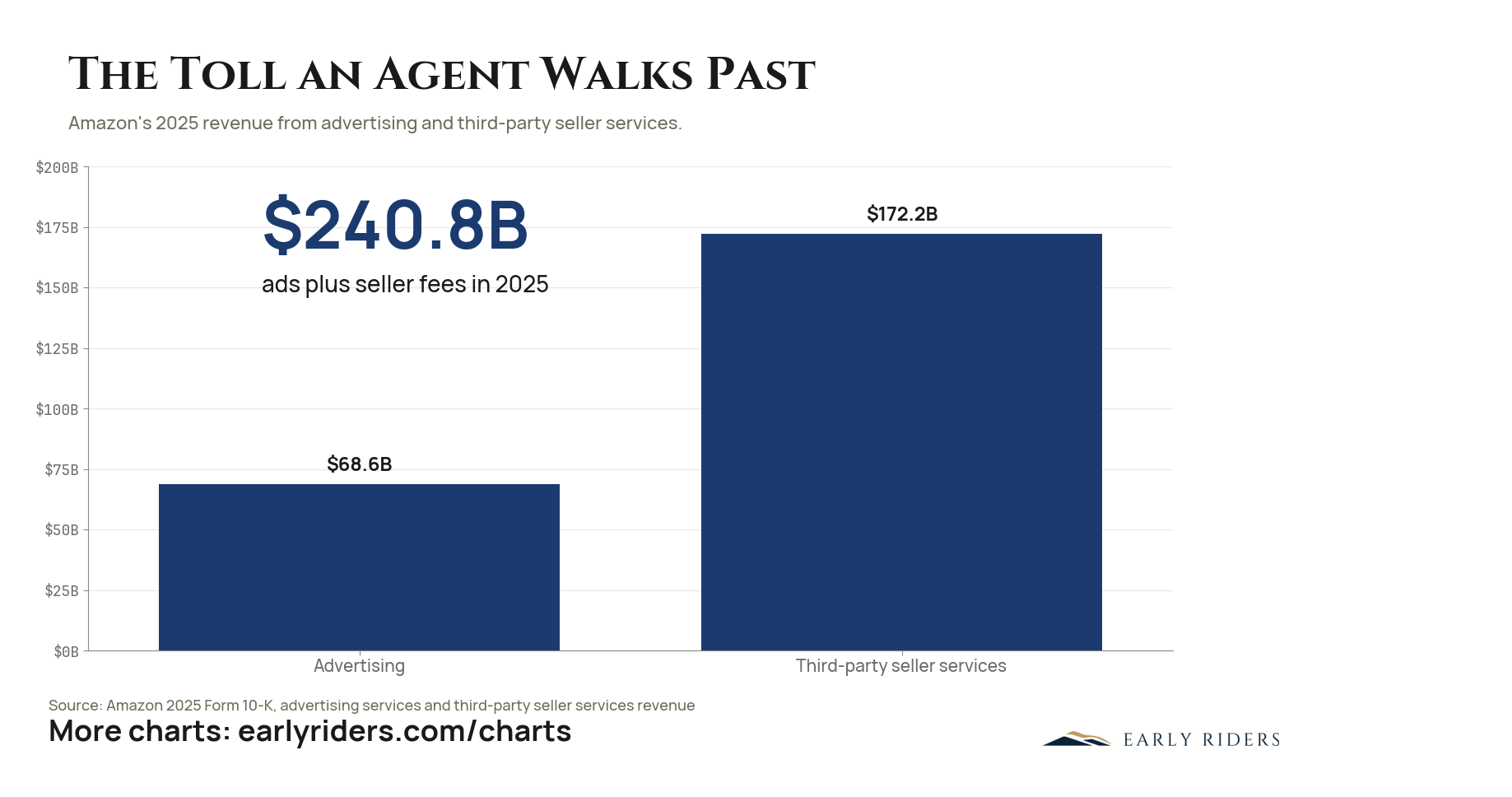
Amazon made $68.6 billion from advertising last year and $172 billion from fees on third-party sellers, and both depend on a person scrolling its pages. An agent reads no ads. Muse checks out through Stripe's Link with a saved card or a single-use virtual one, and Meta says it will earn a small fee on every transaction.
Amazon has a real case. It says Muse does not identify itself and appears to store customer credentials, and after the Ninth Circuit ruled in August that a shopping agent is a tool, it is enforcing its terms of use instead. eBay won this fight in 2000 against a bot hitting its site 100,000 times a day, then paid $1.5 billion for PayPal two years later.
Every rail Muse uses today is a card in dollars, and agents made up at most 7.5% of the $25.6 million in real commerce on x402, the protocol built for machine payments. BlackRock's new paper cites simulations in which AI models chose stablecoins for spending and bitcoin for saving. For now the gains go to Meta, which owns the agent, and to the card networks beneath it, while Amazon keeps the door.
News of the Week
US spot bitcoin ETFs took in $999 million on September 21, the peak of a six-session run worth about $2.84 billion that swung year-to-date flows from a $5.8 billion deficit in mid-July to about $800 million positive.
The 10-year Treasury yield hit 5.12% this week, its highest since 2007, while the 30-year reached 5.37% and traders priced about 70% odds of another Fed hike in October.
Presidents Trump and Xi extended their trade truce by two months at a Washington summit, pushing tariffs, rare-earth supplies and technology restrictions into the next round while China still lags a pledge to buy $17 billion of other agricultural goods.
Akamai signed an $11.6 billion, seven-year compute deal with Anthropic, with an option for $9 billion more, and gave Anthropic warrants for roughly 5% of the company. Akamai shares jumped more than 20% after hours.
Brookings estimated the US AI buildout will cost $10.3 trillion from 2025 to 2032, about 3.63% of GDP a year. On Thursday, Oracle declared force majeure on its $165 billion Project Jupiter site, whose debt trades below 90 cents on the dollar.
DeepSeek's annualized revenue run rate hit $1 billion, more than double a few months ago, as it seeks 50 billion yuan ($7.45 billion) at a 500 billion yuan valuation, The Information reported. Reuters could not verify the report.
Digital asset roundup
Coinbase added fixed-rate bitcoin-backed loans through Morpho Midnight on Base, letting users lock a rate and repayment date up front, extending a loan book that already tops $1.4 billion against roughly $3 billion of collateral.
White-hat hackers moved 52.37 bitcoin, worth over $4.5 million, from the Coldcard exploit into a Wyoming recovery trust, according to Galaxy Digital's Alex Thorn. Galaxy counts 1,789.28 bitcoin lost in the attacks, so about 97% is still unrecovered.
Binance bought $100 million of Circle Class A stock at $80.84 a share with a two-year lock-up, alongside a five-year deal under which Circle pays Binance a monthly fee tied to USDC held through Circle's wallet infrastructure service.
Ondo launched three tokenized portfolios built on BlackRock model strategies for eligible investors outside the US, the first time onchain investors can reach BlackRock-designed strategies through a single token. Ondo already holds over $3.5 billion across more than 440 tokenized securities.
Bitget lost $387.5 million from its hot wallets, CEO Gracy Chen said, and blamed hackers linked to North Korea. The exchange says its user protection fund, which holds more than $464 million, will be used to cover the losses.
Open source
Xiaomi released MiMo-V2.6-Pro under an MIT license, a trillion-parameter model with 42 billion active that Artificial Analysis ranks first of 114 open-weight models with an Intelligence Index score of 46. Reinforcement learning for its two models cost about $3.5 million.
NVIDIA released Nemotron 3 Diarization, a 100 million parameter open-weight model under the OpenMDW 1.1 license that tracks up to eight overlapping speakers and ranked first of 12 systems on Diarization-Bench with a 14.72% error rate.
Epoch AI found the cost of reaching a fixed level of AI performance has fallen about 47% a quarter since 2023, or 13 times a year, four times faster than DNA sequencing and 18 times faster than lithium batteries.
Researchers at alloc init published a 56-page design for private bitcoin transfers that works without changing Bitcoin, with a two-input, two-output transfer taking 625 vbytes. Its security rests on a trusted setup, and how bitcoin enters and exits is left to a later paper.
Regulation
The Federal Reserve proposed GENIUS Act rules requiring stablecoin issuers to fully back tokens with reserve assets such as short-term Treasury bills, adding capital requirements and a tailored application process for banks that want to issue their own stablecoins, with comments open for 60 days.
CFTC staff updated their March 20 FAQs on September 24 to cover investing customer funds in tokenized forms of permitted investments and using blockchains to meet recordkeeping requirements.
Early Riders Media
Final Settlement: Why Meta's Muse Forces Rapid Bitcoin Adoption
"It's a recognition that that rate hike is almost like ceremonial and that it's not actually going to tame inflation." Brian Cubellis, on bitcoin rising after the Fed hike.
Watch or listen on YouTube, Apple and Spotify.
Thanks for reading. If someone you know should be reading this, forward it to them.
About Early Riders
Early Riders is investing in digital infrastructure at the frontier. Early Riders is the first bitcoin denominated venture firm. Learn more at earlyriders.com.
Subscribe to Keep Reading
Get the full piece, plus all the latest Early Riders research, letters, and the weekly newsletter, delivered directly to your inbox.
Subscribing is free, and this device stays unlocked once you do.