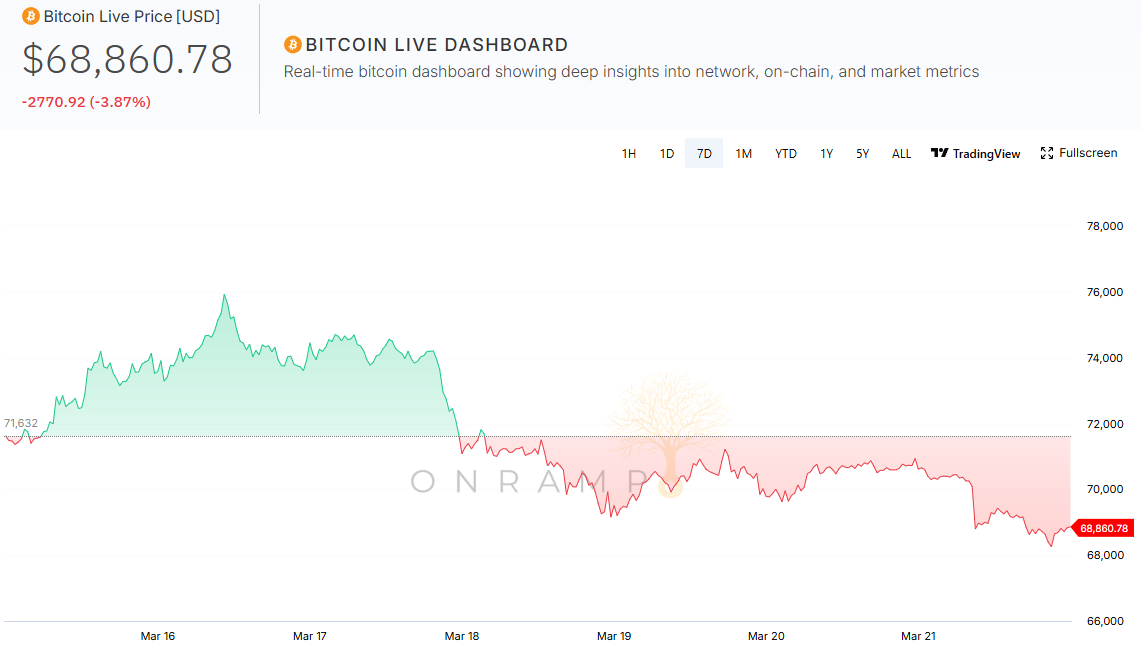
Bitcoin was down (4.0%) this week to a market capitalization of $1.38T.
Early Riders Media
On this week's podcast, the team broke down the accelerating stablecoin infrastructure buildout, the return of the founder-led company era in an AI-driven economy, and what Bitcoin's outperformance during global uncertainty signals about maturing store-of-value demand.
You can find all our episodes on our podcast website as well as listen on YouTube, Apple, and Spotify.
Industry & Institutional Updates
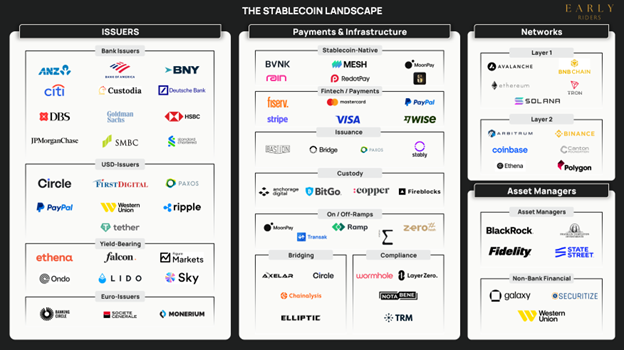
Mastercard agreed to acquire UK-based stablecoin infrastructure firm BVNK for up to $1.8 billion, aiming to bridge on-chain stablecoin payments with its global network for cross-border and B2B transactions.
PayPal expanded its PYUSD stablecoin to 70 markets across Asia-Pacific, Europe, and Latin America as the token's circulating supply surpassed $4.1 billion, extending dollar-backed stablecoin access beyond the U.S. and U.K. for the first time.
Visa Crypto Labs rolled out a command-line interface enabling AI agents to execute programmatic card payments autonomously, marking the company's first move to build dedicated infrastructure for the emerging agentic commerce market.
Hong Kong shortlisted HSBC and a Standard Chartered-led joint venture for its first stablecoin licenses, with the HKMA expected to grant approvals within weeks as the city moves to establish itself as a regulated digital-asset hub.
SBI VC Trade launched Japan's first licensed USDC lending service for retail investors, offering a 10% annualized yield for an initial 12-week term as stablecoin adoption accelerates across the country.
Robinhood Ventures invested approximately $35 million across payments giant Stripe and AI voice startup ElevenLabs through its NYSE-listed startup fund, giving retail investors direct exposure to two of the most sought-after private companies in tech.
Strategy purchased 22,337 BTC for $1.57 billion in its largest single buy of 2026, funded primarily through $1.18 billion in STRC preferred share sales, bringing total holdings to 761,068 BTC.
World launched an identity toolkit built on Coinbase's x402 protocol that provides AI agents with cryptographic proof of human backing via biometric verification, addressing bot abuse as autonomous transactions scale.
Theo raised $100 million through a Genesis Vault to launch thUSD, a yield-bearing dollar stablecoin backed by gold and delta-hedged via CME gold futures, targeting annualized returns of around 10%.
Crypto.com partnered with KG Inicis, South Korea's largest payment gateway serving 190,000 merchants, to enable crypto payments for foreign tourists across the country's commerce ecosystem.
Regulatory Updates
The SEC approved Nasdaq's tokenized equities trading pilot, allowing eligible Russell 1,000 stocks and major ETFs to settle as blockchain tokens alongside traditional shares, with live token-settled trades expected by Q3'26.
The Bank of Korea expanded its digital won pilot to nine banks in Phase 2, beginning real government subsidy distribution via CBDC-linked deposit tokens with plans for large-scale commercial testing in 2H'26.
FINTRAC revoked the registrations of 23 crypto money services businesses in Canada for compliance failures including missed reporting deadlines and ineligible registrations.
What We're Watching
Executive Summary:
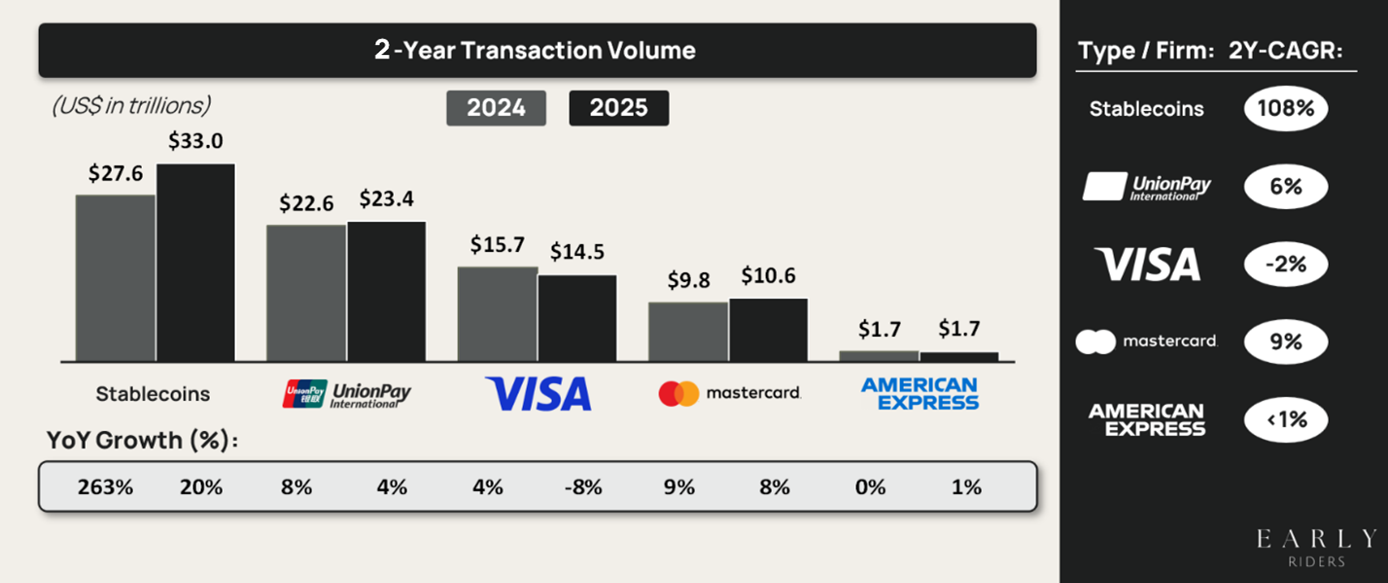
The stablecoin market surpassed $300 billion in total capitalization in late 2025, representing a ~50% year-over-year increase. Annual settlement volume hit $33 trillion, eclipsing Visa’s throughput. Stablecoin issuers now collectively hold more U.S. Treasuries than most sovereign nations. By some estimates the market could exceed $1 trillion in circulation by late 2026 and $2 trillion by 2028, driven by use cases far beyond digital asset trading: B2B settlement, remittances, e-commerce, treasury management, and payroll.
The Current Payment System: Overpriced & Inefficient:
Traditional payment rails rely on multiple intermediaries, driving up costs, slowing transfers, and instances of rejected payments. A typical cross-border transaction passes through a chain of correspondent banks, each extracting fees of 0.3% to 1.0%, before reaching its recipient, often three or more days after initiation. In aggregate, businesses and consumers absorb total fees of 1% to 3% on every international transfer, with settlement timelines spanning multiple business days.
Stablecoins are able to be transacted 24/7/365 with near 0 fees, which represents a significant upgrade to banking institutions, which are only open 23% of hours, slower, and much costlier. This category shift is currently ongoing across all of the fintech space with profound implications.
Stablecoins as The Treasury Demand Engine:
As of August 2026, the US is running annual deficits approaching $2 trillion, with total federal debt just under $40 trillion. The U.S. also has approximately $10 trillion in existing debt that is expected to roll over by the end of 2026. The traditional buyer base for U.S. debt securities has been consistently contracting for the last decade. In 2011, China and Japan alone held nearly 23% of the outstanding US Treasury debt. By late 2024 however, their combined share had collapsed to only 6%. The Federal Reserve, while simultaneously engaged in quantitative tightening, is no longer a consistent buyer either. As a result, The U.S. needs a new and reliable source of demand for its paper, and stablecoins have emerged to meet that need.
The current administration also agrees with this view as Treasury Secretary Scott Bessent has been a direct voice on this thesis. Speaking publicly in May 2025, he stated: “I’ve seen estimates that just over the short term, stablecoins could create $2 trillion of demand for US Treasuries and Treasury bills. Put that in context, the number is probably about $300 billion right now.” Bessent further argued that “a thriving stablecoin ecosystem will drive demand from the private sector for US Treasuries, which back stablecoins. This newfound demand could lower government borrowing costs and help rein in the national debt.” Both Scott Bessent and President Trump’s administration understand the significant opportunity that stablecoins bring to the U.S.
Dollar-backed stablecoins require reserves, and under the GENIUS Act signed by President Trump in July 2025, those reserves must be held in high-quality liquid assets, with short-term US Treasuries included. Every dollar of stablecoins issued is, in effect, a mandated buyer of US government debt. Bessent, speaking at the Treasury Market Conference in November 2025, noted that the stablecoin market, currently valued at around $300 billion, “could grow tenfold by the end of the decade thanks to the GENIUS Act.”
The geopolitical dynamic is equally impactful as dollar-pegged stablecoins now represent over 99% of the total stablecoin market cap. Their growth also extends dollar-denominated financial access to hundreds of millions of people globally, generating additional global demand for U.S. securities. At the signing of the GENIUS Act, Bessent described the administration’s plans in a single statement: “The dollar now has an internet-native payment rail that is fast, frictionless, and free of middlemen.” Federal Reserve Governor Stephen Miran also reinforced this view, noting that “stablecoins are already increasing demand for US Treasury bills and other dollar-denominated assets by purchasers outside the United States, and that this demand will continue growing.” The US government has structurally aligned its fiscal interests with the growth of the stablecoin sector, a clear catalyst for its growth.
The World Needs Digital Dollars:
For the majority of the world’s population, the local currency is not a reliable store of value. Inflation rates across Latin America, Africa, and the Middle East, routinely outpace those in the US. In some cases, countries in these regions are running at double digit inflation rates or worse on a sustained basis. In these environments, holding local currency is a slow and predictable loss of purchasing power. The US dollar, by contrast, represents stability, global acceptance, and access to the world’s largest financial system.
Until now, accessing and holding dollars required a bank account, a functioning financial institution, and in many cases, a government willing to allow it. Stablecoins remove all three barriers. An individual in Argentina, Nigeria, or Turkey, can hold dollar-denominated value with no bank, no intermediary, and no permission required. The global application of stablecoin technology represents billions of new potential users, who are choosing between a dollar in their pocket, and a local currency that erodes the moment that they receive it.
Chart of the Week
Global Stablecoin volumes reached $33 trillion in 2025, up 20% from 2024.
Stablecoin volumes are growing much more rapidly than existing financial payment rails provided by firms such as Visa, Mastercard, and American Express.
Find this valuable? Please forward this to someone in your network who may find benefit from the information.
Early Riders is the first bitcoin-denominated venture firm, raising, holding, investing, and returning capital in bitcoin. Learn more about how to get involved www.earlyriders.com.
Make sure to keep up with all our research at earlyriders.com/research.
Subscribe to Keep Reading
Get the full piece, plus all the latest Early Riders research, letters, and the weekly newsletter, delivered directly to your inbox.
Subscribing is free, and this device stays unlocked once you do.