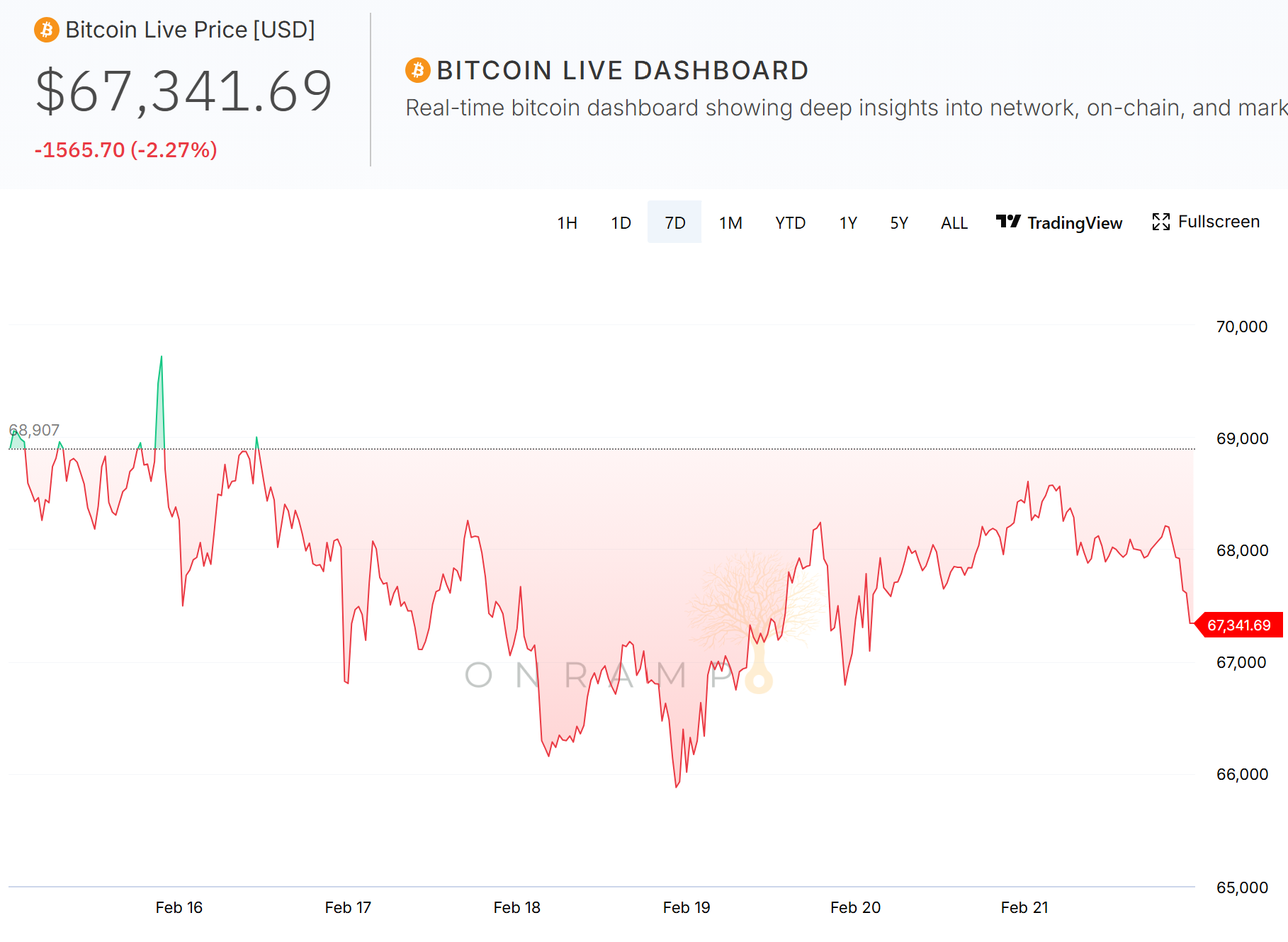
Bitcoin was down (2%) this week to a market capitalization of $1.35T.
Early Riders Media
This week's podcast explored OpenAI's acquisition of OpenClaw, the trade-offs between tools like OpenClaw and Claude Cowork, and the increasing need for neutral permissionless assets as trust in the traditional systems continues to erode.
You can find all our episodes on our podcast website as well as listen on YouTube, Apple, and Spotify.
Industry & Institutional Updates
Abu Dhabi held over $1 billion of BlackRock's Bitcoin ETF at the end of last year, demonstrating significant sovereign adoption.
An unknown Hong Kong investment firm became the largest new IBIT holder with a $436 million stake acquired last year.
Italy's Intesa Sanpaolo disclosed adding $96 million in spot Bitcoin ETF exposure alongside a $184 million MicroStrategy put option hedge, marking significant European banking adoption.
Mirae Asset acquired Korbit, one of South Korea's oldest digital asset exchanges, expanding its existing footprint in the space.
CME announced plans to offer 24/7 digital asset derivatives trading by as early as May of this year.
deBridge launched MCP, enabling AI agents to execute non-custodial cross-chain transactions completely autonomously.
American Express and Visa alumni raised $4 million for Rhythmic, a payment infrastructure startup focused on digital asset integration.
Gemini exchange parted ways with its CFO, COO, and CLO in a major executive shakeup this past week.
Ledn closed a $188 million Bitcoin-backed bond sale secured by over 4,000 BTC, marking the first institutional-grade asset-backed securities built from consumer digital asset loans.
Regulatory Updates
The Dutch House advanced a 36% tax law on unrealized digital asset gains.
Brazil proposed a national Bitcoin reserve, in which it announced plans to purchase as much as 1 million bitcoin over the next five years, joining the growing list of countries seeking exposure.
Hong Kong's primary regulator approved the first digital asset company license since June, signaling renewed regulatory momentum in APAC for digital assets.
Stripe's stablecoin bridge won conditional OCC approval for a national bank charter, enabling regulated stablecoin payment infrastructure.
What We're Watching
Agents, Commerce, and The Future of Money Movement
Why Agents Will Need Money
AI agents are moving from answering questions to taking actions, booking infrastructure, purchasing API calls, paying other agents for completed tasks, and many are wondering the rails to be used. The moment an agent acts on behalf of a human in the real world, it needs a way to pay. An agent can use traditional rails, a funded bank account via API, or a credit card a user grants access to. But those systems were built for humans: rate limits, fraud, settlement delays, business-hours-only processing, credit card fees, chargebacks, and zero interoperability with other agents. Bitcoin & stablecoins give agents programmable, 24/7, instant settlement with micropayments and significantly lower fees.
Roughly $50B in agentic commerce was conducted in 2025, and is growing rapidly thus far in 2026.
The Dollar Is the Default
When you build an autonomous agent that needs to pay for cloud computing, negotiate API pricing, or settle a micro-transaction with another agent, you need a unit of account with high liquidity, network effects, and which both humans and agents understand. Today, that’s a tokenized version of the dollar for most parties.
The dollar accounts for about 88% of all global foreign exchange transactions, and the total circulating supply of outstanding stablecoins is over $300B. Stablecoins are the most liquid digital representation of the most widely accepted currency on Earth. Companies with significant payment and savings distribution are building solutions with that in mind.
This is why virtually every company building payment infrastructure: Stripe with its stablecoin issuance and payment integrations, PayPal with PYUSD, and Visa with multi-chain stablecoin settlement has pivoted to incorporating stablecoins. The demand signal is clear: enterprises with distribution are building products for stablecoins, not digital assets more broadly. Today their customers understand dollars.
For an AI agent processing thousands of micro-transactions per hour, price volatility is the enemy. A payment rail that fluctuates 5% between initiation and settlement breaks the math on thin-margin autonomous commerce. Dollar-denominated stablecoins eliminate that variable entirely. The agent knows exactly what it's spending, and the counterparty knows exactly what it's receiving.
Humans supervising and prompting these agents think in dollars. Many agents are and will be working on behalf of enterprises, and working with agents managing non USD currency will be suboptimal.
Permissioned Money as Incompatible With Agents
Stablecoins are permissioned money. USDC has a blacklist. Tether freezes wallets. Every major stablecoin issuer operates under regulatory frameworks that require them to comply with government directives, including freezing funds, blocking addresses, and restricting access by jurisdiction.
For a human making a few transactions a day, this rarely matters. For an AI agent executing thousands of autonomous transactions across borders, it becomes a structural risk.
Imagine an agent negotiating compute pricing with a counterpart in a jurisdiction that gets sanctioned next quarter. Or an agent-to-agent payment network where one node's funds get frozen because of a compliance flag triggered by a pattern-matching algorithm, not fraud, just a false positive. At machine speed and machine scale, the friction of permissioned money compounds from inconvenience into systemic fragility.
Agents are global and will work with information and access points across the world. That means that agents prompted by people in sanctioned countries will use USD, and the agent to agent money transfer will eventually flow back to humans. Money laundering controls will ramp up, and agents will unknowingly interact with agents working on behalf of sanctioned individuals and countries and have their money frozen.
The Endgame Is Neutral Money
Bitcoin solves the censorship problem and the walled garden problem simultaneously. It's the only major monetary network where no single entity can freeze a transaction, blacklist an address, or gate access by jurisdiction. For autonomous agents that need to transact freely, continuously, and globally, bitcoin is the only asset decentralized enough to ensure 24/7 micropayments and true asset ownership.
The volatility objection fades as Bitcoin's market cap grows, just as it has over time. Bitcoin's 30-day realized volatility has already declined from over 80% in 2017 to under 40% in recent years, and that trend continues as the asset matures. Over more time, bitcoin’s ownership will become more decentralized and payment networks will increasingly turn on access. For agents the volatility premium becomes a manageable cost of doing business, one that's worth paying for censorship-resistant, globally fungible settlement.
It's increasingly clear that while in the near term agentic payments will happen on stablecoins, asset seizures, walled gardens, and confusion will drive the shift to neutral money.
Chart of the WeekNo digital asset firms received banking charters in 2024, yet 6 different firms received approvals in 2025.
Stablecoins have played a notable role to-date in encouraging regulators to expedite OCC approvals.
Find this valuable? Please forward this to someone in your network who may find benefit from the information.
Early Riders is the first bitcoin-denominated venture firm, raising, holding, investing, and returning capital in bitcoin. Learn more about how to get involved www.earlyriders.com.
Make sure to keep up with all our research at earlyriders.com/research.
Subscribe to Keep Reading
Get the full piece, plus all the latest Early Riders research, letters, and the weekly newsletter, delivered directly to your inbox.
Subscribing is free, and this device stays unlocked once you do.