
News of the Week
Bessent could tap near $1 trillion Treasury General Account to fund bond buybacks following the announcement to increase sizes of long-end liquidity support buybacks, partially responsible for bitcoin’s 20+% jump over the past week.
Citi reiterated its plans to go live with digital asset custody later this year, starting with bitcoin.
Stripe agreed to acquire OpenRouter at a rumored $7.5B valuation. In a leaked letter to investors, Stripe declared the singularity occurred in January 2026.
Nvidia discusses Perplexity investment at $30 billion-plus valuation. Perplexity’s annualized revenue has risen to more than $750 million from less than $250 million at the start of the year, the report said.
Unitree Robotics pops 542% in its Shanghai debut as investors jumped on the opportunity to invest in the profitable robotics maker. Over the weekend, the World Humanoid Robotics impressed, showcasing the progress of the technology.
OpenAI paused reinforcement learning for its latest model for a few weeks to ensure alignment following the hugging face hack incident.
Digital asset roundup
Ramp added audit and attribution trails for x402 payments.
Binance launched Binance OS and MCP,
Bitari filed to raise $30M in an initial public offering to expand its Bitcoin mining & HPC infrastructure.
Metaplanet to invest 2,100 Bitcoin in Super League to Launch U.S. Bitcoin Treasury Platform, Superplanet.
Open source
Nvidia is planning to use its $6 billion deal it struck this week with Poolside to build one of the world’s most powerful open-weight AI models, as it brings most of that company’s employees in house.
Qwen launched Qwen3.8 27B. The model is small enough to run on local hardware for most casual users, and offers one of the best cost / performance ratios out of existing models.
Hugging Face, an AI developer platform, has been exploring a potential $13 billion sale, highlighting its key role in the AI ecosystem.
Thinking Machines offered its model free on OpenRouter for the next few weeks in order to better understand its usage in the real world.
A new paper suggests the ability to manage keys on the lightning network through multi-signature key management.
Regulation
SEC proposes new crypto offering rules as Congress stalls on digital asset legislation. Major changes include treating certain stablecoins as cash equivalents under GAAP and clarification around token fundraising.
President Trump urged Congress to break its deadlock on the Clarity Act during a White House meeting with crypto executives on Wednesday.
Voters are moving forward with plans to oust officials over data centers in local elections.
What We’re Watching
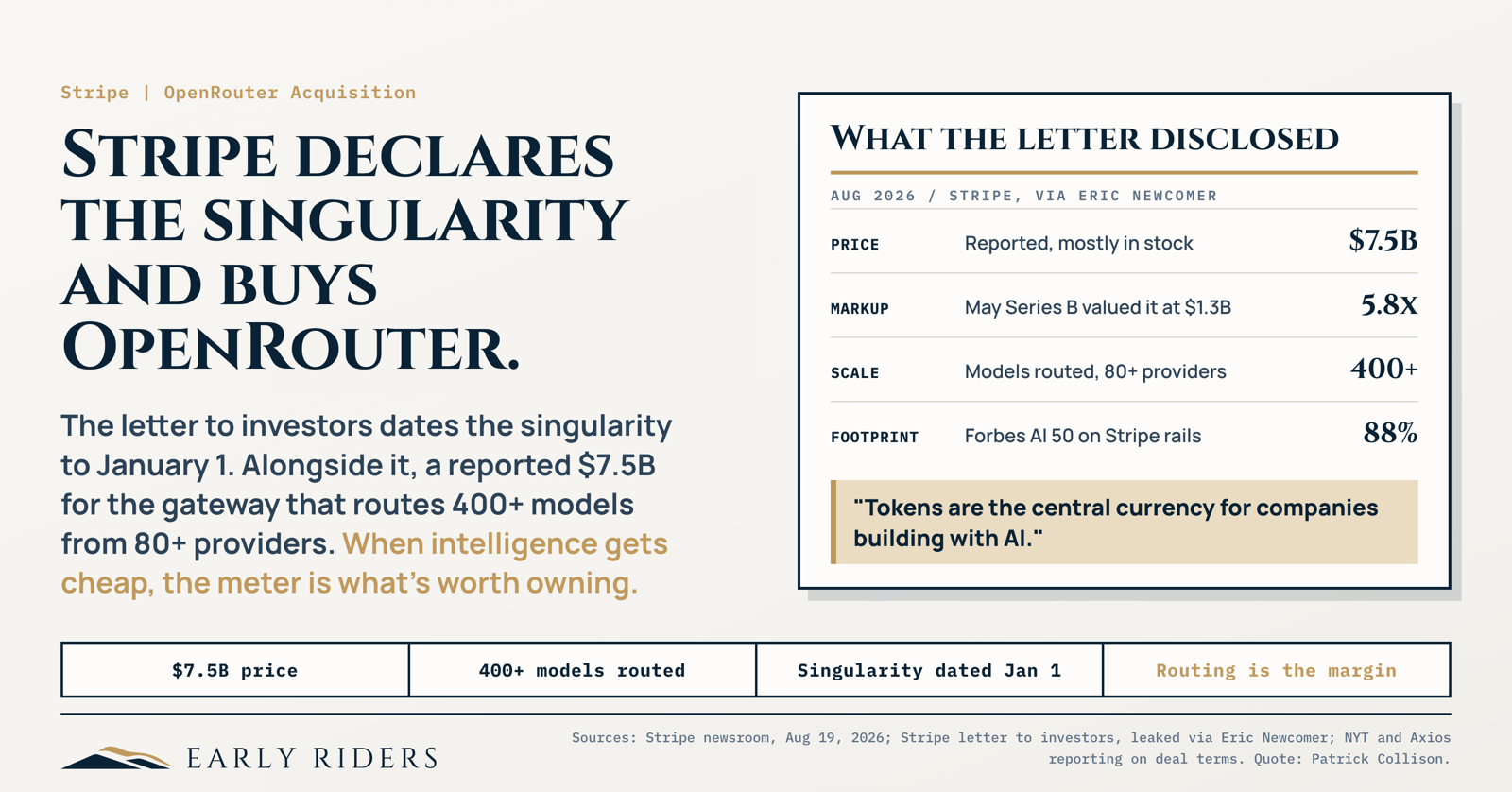
Stripe bought OpenRouter and told its investors the singularity began on January 1.
Stripe has been running the business in the singularity for eight months, citing a sharp rise in the rate of new firm creation, first-half revenue up 41% year over year, and revenue from “AI and crypto” more than doubling as a share of the business. Alongside the letter, Stripe confirmed it is acquiring OpenRouter, the gateway that routes requests across 400+ models from more than 80 providers, for a reported $7.5B, mostly in stock. OpenRouter raised its Series B at a $1.3B valuation in May.
The cost to complete a real unit of work with AI has fallen one to two orders of magnitude in three years, and the bigger the job, the faster the cost has fallen. AI task autonomy is doubling faster than Moore’s Law ever did, because the tool being improved is now also the tool doing the improving, and each capability gains feeds the next one. A step change in the rate of new company formation is what that looks like when it reaches the economic data: when the cost of useful output collapses, the cost of starting a company collapses with it. Stripe sits on the receipts for a large share of the internet economy, so when it says the trend lines broke in January, that is worth taking seriously.
“Tokens are the central currency for companies building with AI” was one notable line from the letter. Token prices have fallen roughly 305x in three years, and every new frontier release reprices the market again. When the product deflates that fast, profits get competed away at the model layer and move to the businesses that sit between buyers and sellers of intelligence. OpenRouter is the plainest version of that business: a boring, trusted primitive that one developer can adopt in minutes, taking a small cut of an exploding flow.
Stripe has run this play before. It bought Bridge for $1.1B to own stablecoin settlement while the industry argued about which issuer would win. Now it has bought the model gateway while the industry argues about which lab will win. In both cases the bet is the same: the individual winners are unknowable, the flow itself is not, and the neutral layer that routes the flow is one area that will continue to be valuable.
Subscribe to Keep Reading
Get the full piece, plus all the latest Early Riders research, letters, and the weekly newsletter, delivered directly to your inbox.
Subscribing is free, and this device stays unlocked once you do.