The Neutral Account Layer for the Stablecoin Economy
Stables is building the universal operating account for stablecoins.
One regulated account where businesses hold fiat and any major stablecoin, settle cross-border payments 24/7, and manage treasury, payroll, card spend, and compliance from a single platform. The company handles onboarding, custody, routing, conversion, settlement, off-ramping, reconciliation, and reporting through one integrated product, consolidating what businesses currently have to assemble across multiple wallets, exchange accounts, banking partners, and audit systems.
Stablecoins already settle faster than legacy rails, eliminate the correspondent banking intermediaries that consume 1 to 3 percent of every cross-border transfer, and operate continuously outside banking hours. The adoption case is no longer theoretical. SpaceX collects Starlink revenue from emerging markets through stablecoin rails. Meta and DoorDash deploy stablecoin-based creator and driver payouts across dozens of countries. JPMorgan’s Kinexys platform has processed more than $1.5 trillion in institutional transfers on a dollar-backed token. Stablecoin transaction volume exceeded $33 trillion in 2025, operating at the scale of major card networks. This is mainstream commercial infrastructure now.
What has changed in the last twelve months is the regulatory and issuance landscape. MiCA established a unified authorization framework across Europe. The GENIUS Act created the first federal payment stablecoin framework in the United States. And critically, infrastructure platforms like Bridge now allow any business to launch a branded stablecoin on regulated, reserve-backed infrastructure without obtaining its own license. Phantom, MetaMask, and Hyperliquid have already issued stablecoins on this model. Banks, payment companies, and enterprises can now reach stablecoin issuance in weeks rather than years. The result is a wave of new issuers entering the market simultaneously, each incentivized to build a walled garden around their own coin. That fragmentation creates a proportional need for the neutral layer that routes, reconciles, and settles across all of them.
“Each new stablecoin is effectively its own currency with its own issuer risk, chain risk, and redemption mechanics, and every business holding more than one now has to manage them as separate currencies they did not choose.”
The Full Product Suite
Stables is that layer. The product compresses what today requires five or six vendors into one account with one onboarding, one compliance framework, and one dashboard. The core business is stablecoin payment orchestration at a fraction of legacy correspondent banking costs, with settlement in minutes instead of days. Beyond core settlement, Stables is building the full financial stack around the account: cards, automated treasury management, lending and borrowing, on/off-ramping, and FX conversion. The high-value end state is a self-service treasury management platform that delivers what banks charge a fortune for today, with faster settlement, lower fees, and no banking relationship to manage, accessible to SMBs and global regions that traditional banking partners have never served well.
The Bitcoin Symbiosis
Beyond anything else that has emerged from the digital asset ecosystem, stablecoins are the one application outside of Bitcoin to achieve genuine commercial traction. Enterprises, banks, and regulated institutions are building permissioned stablecoin networks with compliance infrastructure around them, bringing the benefits of faster settlement and lower fees than traditional networks together. That process normalizes digital financial rails at scale and serves as a meaningful tailwind for Bitcoin, creating the institutional familiarity, on-ramps, and infrastructure that accelerate the broader transition to a Bitcoin-native financial world. Stablecoins and Bitcoin are acting in a symbiotic manner to onboard users to faster and cheaper rails while bringing better savings technology. Both sides accelerate the other and will mutually grow total addressable markets together.
Path to Launch
- Beta launch targeted for Q3–Q4 2026, ahead of the GENIUS Act enforcement date in January 2027
- An active pipeline of warm commercial relationships and businesses already on the waitlist
- Founding team led by Kelghe D’Cruz, co-founder of Fideum and advisor to the El Salvador Bitcoin initiative
- Operators across regulated payments (Mastercard Lighthouse, PayCargo), institutional banking (RBC Global Treasury, Bank of America), digital asset infrastructure, and institutional go-to-market
The GENIUS Act Problem
The fragmentation problem is not new. What changed is the GENIUS Act.
Operating across multiple digital assets, chains, and touchpoints for institutional clients has been an open problem in regulated digital finance for years. At Fideum, the team encountered it constantly. The infrastructure and licensing existed only in pieces, and no single vendor could deliver an integrated account that worked across the asset, chain, jurisdictional, and operational dimensions a real business needed. What is now clear is that each stablecoin operates as its own currency with its own issuer risk, chain risk, and reserve composition, and businesses holding more than one are managing currencies they did not choose. That is the same fragmentation problem D’Cruz encountered at Fideum, scaled across the institutional stablecoin economy.
The first federal payment stablecoin framework in the United States, alongside MiCA in Europe, has reframed stablecoins as legitimate primary instruments for commercial settlement. Banks, payment networks, and enterprises now have a regulatory pathway to issue, hold, and move stablecoins at scale. New issuers, corridors, and use cases are coming online every month. The structural problem D’Cruz spent years inside at Fideum is about to scale across the entire institutional stablecoin economy.
“Visa did not pick which bank would win. Visa built the network that let them all work together.”
— The network logic, applied to stablecoins
Stables is the answer to that problem, built by an operator who has carried it for years and is now moving against it with regulatory wind at the back. Stables is applying that same logic to stablecoins: one regulated account, multiple issuers, multiple chains, multiple jurisdictions, all reconciled and settled through a single operating layer.
D’Cruz co-founded Fideum, the regtech and digital banking infrastructure platform, where he spearheaded the engagement that won Mastercard’s Lighthouse program. Fideum later took strategic investment from Valereum (VLRM.AQ), and D’Cruz remains a shareholder as the business works through a strategic transaction. Beyond Fideum, D’Cruz has worked directly with regulators and sovereign governments on digital asset infrastructure, including an advisory role on the El Salvador Bitcoin initiative that established BTC as legal tender. The throughline across these engagements is a working understanding of the compliance, licensing, and political dynamics that determine whether digital asset infrastructure actually ships.
One Account Architecture for a Fragmented Workflow
Every stablecoin is its own currency. Each one carries distinct issuer risk, chain risk, redemption mechanics, and reserve composition, and a business holding more than one is effectively running a multi-currency treasury without the tools to manage it.
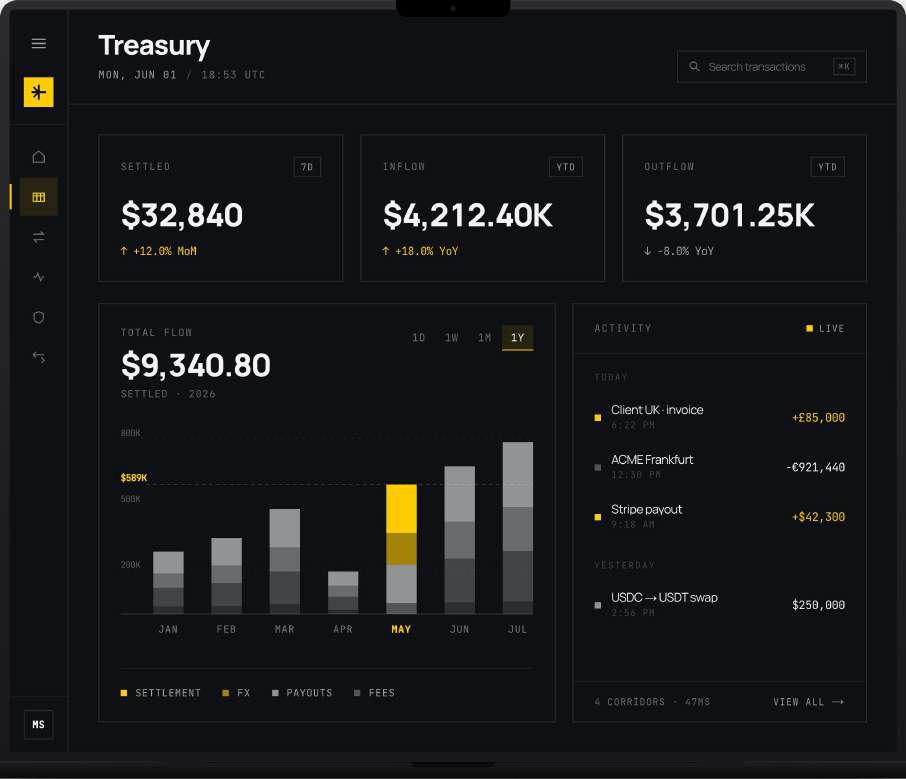
Stables consolidates a fragmented stablecoin workflow into a single account architecture. A business moving value across stablecoins often needs several tools such as wallets, exchange accounts, banking partners, compliance vendors, accounting workflows, and regulatory-compliant reporting layers. Each handoff adds cost, delay, and operational risk. Stables compresses that workflow into one simple and automated platform.
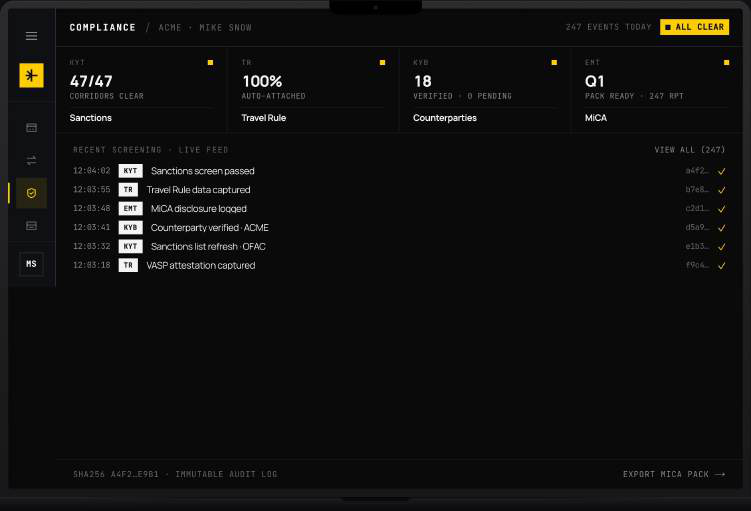
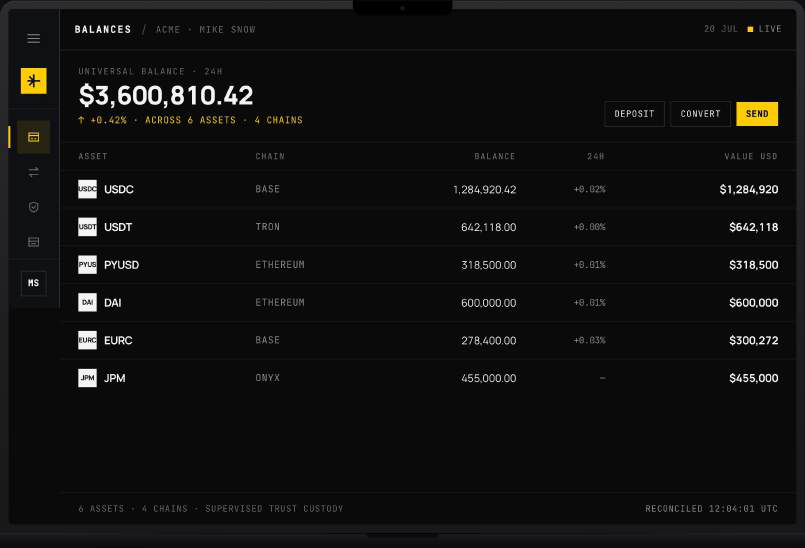
The product begins with onboarding. Customers complete one KYC or KYB process and can then hold supported stablecoins and fiat balances through segregated custody and daily reconciliation. Travel Rule data is captured at transaction initiation and carried through the settlement flow. The platform is designed to support all chains, and customers can see balances, transactions, and market insights in an all-in-one dashboard.
Settlement is designed to be always available at the core. Stables routes payments across supported chains and it converts into fiat or other supported assets through embedded FX and treasury APIs. Off-ramp and payroll functions connect supervised balances into SEPA, ACH, Fedwire, wire, and card rails. Reporting provides audit logs, transaction histories, and MiCA-aligned disclosures where relevant.
The long-term product surface extends beyond a wallet. Stables can become a business account, treasury dashboard, compliance layer, payroll rail, card program, white-label stablecoin platform, and settlement API. The same infrastructure can serve banks, fintechs, marketplaces, and cross-border businesses. This breadth of offerings allows stablecoin operations to automatically integrate within treasury, accounts payable, payroll, financial reporting, and regulated settlement.
Core Platform Components
One supervised ledger, compliance by design, always-on settlement, treasury APIs, fiat rails, and white-label infrastructure.
Universal Account
One supervised ledger for supported stablecoins and fiat balances. Includes role-based permissions and finance-team reporting.
Compliance by Design
KYC, KYB, KYT, sanctions screening, Travel Rule data capture, transaction monitoring, and audit logs.
Always-On Settlement
Stablecoin settlement and corridor routing designed for speed, transparency, and low cost relative to legacy cross-border rails.
Treasury and FX APIs
Conversion, cash management, reconciliation, risk management, and treasury workflows through APIs and dashboard tools.
Fiat Rails and Cards
Off-ramps, payroll, wire, ACH, and card functionality through owned and partnered infrastructure.
White-Label Infrastructure
APIs for fintechs, banks, and marketplaces that need stablecoin functionality without building a full compliance and settlement stack.
Pulled Forward by Enterprise Demand
Stablecoin adoption is being pulled forward by enterprise demand and further accelerated by regulatory clarity and payment networks’ adoption. Use cases have emerged beyond digital asset trading, including B2B settlement, remittances, e-commerce, treasury management, payroll, and institutional settlement. MiCA created an operational framework for stablecoin issuers in Europe. The GENIUS Act created the first federal payment stablecoin framework in the United States. Visa has expanded stablecoin settlement and Stripe’s Bridge acquisition validated strategic demand for stablecoin infrastructure. Large banks are also exploring stablecoin issuance and shared rails. These signals show stablecoins moving into regulated financial infrastructure.
The market has grown rapidly over the last five years as the total stablecoin market cap has reached more than $320 billion with more than $33 trillion in annualized transaction volume. USDT and USDC still dominate issuance, while bank, enterprise, and payment-network initiatives continue to expand. As institutional adoption continues to scale, stablecoin usage will continue to increase. As a result, broader usage increases fragmentation across different stablecoins. Ultimately, a business may receive numerous different stablecoins from marketplaces, banks, payroll providers, and digital asset-native counterparties. This fragmentation requires a neutral operating layer that turns each additional rail into another supported settlement path.
Today, legacy cross-border payment infrastructure remains costly, complicated, and slow. Traditional payment rails rely on correspondent banks, currency conversion vendors, and delayed settlement windows. Cross-border transfers often absorb 1 to 3 percent in aggregate fees, with settlement timelines spanning multiple business days. Remittance costs remain near the mid-single digits globally and correspondent banking coverage has continually declined over the last decade, particularly for emerging markets. Stablecoins improve the speed and programmability of money movement.
Market Snapshot
| Metric | Detail |
|---|---|
| Stablecoin Market Cap | $320B+ in total market capitalization, up from near zero five years ago |
| Transaction Volume | $33T+ annualized, operating at the scale of major card networks |
| Legacy Cost | Cross-border transfers absorb 1–3% in aggregate fees with multi-day settlement windows; remittance costs remain near mid-single digits globally |
| The Opening | Enterprise adoption still requires compliance, reconciliation, fiat settlement, and multi-issuer acceptance. Stables is leveraging that intersection. |
Two Phases, One Product Surface
Stables enters the market in two phases. Phase 1 is digital-native, where stablecoin fluency and direct team access mean the build and the buyer move in parallel. Phase 2 expands into legacy segments where the pain is real but adoption lags. The sequencing is deliberate, and the build is consistent across both phases: launch wedges and expansion verticals use the same product surface with different positioning. Distribution through Early Riders’ existing network operates alongside both phases, giving Stables warm access to crypto-native high-net-worth spending from day one.
Phase 1 · Digital-Native Firms
DAOs, foundations, protocols, OTC liquidity desks, and crypto-native SMBs are the natural first customers. Stablecoin fluency is already present and onboarding friction is low. These organizations hold digital treasuries, pay contributors across jurisdictions, run vendor and grant payments, and need policy management and public audit trails that today’s tooling does not deliver cleanly. Stables supports third-party payouts without requiring recipient onboarding, embedded swaps for asset conversion before settlement, and reporting that produces a single audit-ready ledger across multiple stablecoins and chains. OTC liquidity desks are a notable sub-segment, using Stables as a complementary settlement rail that avoids the traditional banking scrutiny that slows fiat-crypto flows.
Phase 1 · Issuer and Chain Partnerships
Stables operates as the end-to-end usability layer that stablecoin issuers and chain ecosystems can route their clients through to drive real adoption. The team holds active relationships across M0, Circle, Base, Avalanche, Solana, Tron, and other ecosystem partners. As new banks, payment networks, and enterprises issue branded stablecoins, the platform that turns a freshly minted coin into something a business can actually hold, spend, settle, and reconcile becomes critical to issuer adoption. Stables provides that layer, and the partnerships give Stables warm distribution into the customer bases each issuer and chain is building, while positioning Stables as the preferred orchestration partner for the next wave of issuers entering the market.
The Wedge
A third launch path runs through Stables’ anchor investor and partner network rather than through a vertical. Early Riders and Onramp Bitcoin operate a $500M+ HNWI and corporate client base of crypto-native individuals who currently navigate three or more touchpoints to convert crypto into fiat into card spend for purchases like private aviation charters, luxury goods, hospitality, and experiences. Wise Capital, an additional advisor channel, operates as a concierge service for the same client profile. Stables compresses these flows into one regulated account where crypto-native HNW clients can pay vendors directly without routing through OTC desks and traditional banks. The TAM here is smaller than the launch wedges, but the channel is warm, the customer profile is already onboarded to the partner ecosystem, and the use cases produce repeatable, high-margin transaction flow from day one.
Phase 2 · Real Estate
Cross-border real estate is the first legacy wedge Stables targets. International buyers purchasing property in the US, Europe, and emerging hotspots such as Lisbon and El Salvador face wire-transfer friction, 24-hour deposit windows, and settlement timelines that wires cannot meet. The clientele is not the buyer directly but the brokerages and law firms that hold escrow. Stables provides a regulated settlement layer that compresses these flows into instant, auditable transactions. The category has no dominant provider and there is a marketing flywheel through high-profile realtors who are already publicly accepting crypto payments.
Phase 2 · Enterprise Stablecoin Proliferation
As banks, payment networks, and global brands issue their own stablecoins, traditional businesses that interact with multiple of them will face the same fragmentation problem Stables solves for digital-native firms today. Marketing agencies, multi-brand operators, and enterprise vendors that work across Coke, Mastercard, Walmart, and other branded stablecoin issuers will need a neutral acceptance and reconciliation layer. Stables enters this segment as the non-USDC provider with smart API integrations into existing financial workflows, rather than as another standalone interface to learn.
Shipping, Freight, and the Long Tail
Cross-border freight payments among shippers, carriers, ports, customs brokers, and vendors carry recurring working capital constraints driven by delayed settlement across the supply chain. The market is large, the pain is real, and Paul Bradley’s PayCargo network gives Stables direct access to category buyers and category-specific payment workflows. Freight comes online as Stables scales from launch wedges into broader enterprise volume.
SMB treasury, marketplace payments, remittance corridors, white-label fintech infrastructure, and enterprise stablecoin operations each map to the same core need: businesses require one compliant account to hold, move, convert, and report stablecoin balances across jurisdictions. The product surface developed for launch wedges extends into each of these verticals without significant rebuild.
The full cross-border value chain that Stables enables is material: a business can pull local banking information from any supported jurisdiction, convert to the stablecoin with the lowest fees or the one required by the counterparty, route through Stables to the destination, and off-ramp directly into the local currency bank account of the recipient. This end-to-end flow operates without correspondent banks, without manual reconciliation at each leg, and without the multi-day settlement windows that define traditional international transfers.
Stables · Total Addressable Market
| Segment | Size | Description |
|---|---|---|
| Cross-Border B2B | $170T+ | Annual flow of funds between businesses across borders, where settlement delays, correspondent banking fees, and limited corridor coverage create structural inefficiency that stablecoin rails replace. |
| Settlement | $40T+ | The subset of B2B payment volume requiring real-time, multi-jurisdiction settlement infrastructure. Stables earns transaction fees and FX spreads on every dollar routed through its platform. |
| Treasury Management | $15T+ | Corporate cash under active management globally, moving through slow and expensive banking infrastructure that was never designed for modern programmability. |
Revenue Across Flow, Accounts, and Services
Stables earns revenue across flow, accounts, and financial services. Transaction fees apply to cross-border and on-network transfers at competitive rates well below legacy correspondent banking. FX and conversion spreads add revenue on stablecoin-to-fiat and fiat-to-fiat conversion. Tiered monthly platform fees create a recurring subscription layer across Starter, Business, Enterprise, and Institutional accounts, while additional card fees and interchange add usage-based monetization on top.
The enterprise layer expands this model. Treasury management generates fees on cash and stablecoin management, FX conversion, and yield-bearing reserve products for businesses that put stablecoin balances to work. White-label stablecoin and settlement APIs create additional platform revenue from banks, fintechs, and marketplaces that need stablecoin capabilities without their own internal compliance, custody, and settlement infrastructure.
From Partner Rails to Owned Rails
The central margin dynamic is the transition from partner rails to owned or controlled rails. Stables’ unit economics will improve as the firm controls more of the transaction lifecycle. Once Stables proves demand on partner rails, each incremental expansion of owned infrastructure improves gross margins and net take rate, expands corridor coverage, and reduces third-party dependency.
A Fragmented Stack of Partial Solutions
Stables’ wedge is reconciliation.
Stables competes with a fragmented stack of partial solutions. Stablecoin issuers focus on issuance. Wallets and exchanges focus on custody, user access, and conversion. Banks focus on compliance and account access inside closed networks. Each handles one layer well; none handles the whole problem.
The CFO-level reality looks different from the marketing. A business holding USDC, USDT, PYUSD, bank-issued coins, and platform-native coins is running a multi-currency treasury across Ethereum, Solana, Tron, Base, Avalanche, and other chains, with balances scattered across exchanges, custodians, payment processors, and wallet providers.
“Stripe makes it easy to send stablecoins. Stables makes it easy for the CFO to prove the payment was legal, marked-to-market, and reconciled across every stablecoin and chain the business touches.”
— The CFO-level reality
Strategic consolidation is already underway. Stables’ category has produced two of the most significant exits in the space. Bridge was acquired by Stripe for $1.1B in February 2025, validating the market for stablecoin payment infrastructure. BVNK was acquired by Mastercard for $1.8B in March 2026, confirming institutional demand for stablecoin banking. Strategic acquirers are moving on this layer now, and the supply of independent companies at this stage is a small and shrinking set.
The product compresses routing, conversion, settlement, and reporting across every stablecoin and chain into one operating layer that produces a single audit-ready ledger. Defensibility comes from product execution, licenses, corridor coverage, regulatory relationships, transaction history, and enterprise integration depth.
Competitor Landscape
Each competitor handles one layer well. None handles the whole problem, and none offers the compliance-first, stablecoin-native account layer Stables is building.
| Competitor | Position | Key Limitation |
|---|---|---|
| FV Bank | Puerto Rico IFE license with stablecoin functionality | Closest direct competitor by structure, but much more limited in stablecoin coverage, chain support, and universal acceptance. |
| Paxos | Stablecoin infrastructure and issuance | Focused on issuance and settlement rails rather than the full business account stack. |
| Mercury | Well-capitalized SMB banking platform | Built on traditional rails without stablecoin-native functionality. |
| Wise & Revolut | Cross-border and consumer fintech franchises | Significant distribution, but neither offers a compliance-first, stablecoin-native account layer. |
| Digital Asset Banks | Institutional custodians and digital asset banks | Fragmented pieces of the stack at pricing that excludes SMBs and emerging-market operators. |
Bridge to Stripe for $1.1B. BVNK to Mastercard for $1.8B. Strategic acquirers are moving on this layer now, and the supply of independent companies at this stage is a small and shrinking set.
From Thesis to Live Volume
Stables raised pre-seed capital to move from a thesis and partner-supported vision into live volume and a repeatable commercial wedge. The immediate use of funds is focused on Phase 1 team buildout, product engineering, custody and payment rail integrations, compliance systems, brand launch, and beta deployment.
Capital will support the account experience, treasury and settlement APIs, compliance workflows, dashboard reporting, and partner integrations.
The primary go-to-market focus is digital asset foundations, protocol treasuries, OTC liquidity desks, and crypto-native SMBs, with payroll and vendor payouts as the core transaction flows. Shipping and freight forwarding follow in the expansion phase.
Founding Team
The founding team is led by Kelghe D’Cruz, who co-founded Fideum and advised the El Salvador Bitcoin initiative, with operators across regulated payments, institutional banking, digital asset infrastructure, and institutional go-to-market.
Kelghe D’Cruz
Founder & CEO. D’Cruz co-founded Fideum, the regtech and digital banking infrastructure platform that won Mastercard’s Lighthouse program under his leadership and later took strategic investment from Valereum (VLRM.AQ). He also advised the El Salvador Bitcoin initiative, contributing to the work that established bitcoin as legal tender. D’Cruz has operated alongside institutional banks, regulators, and sovereign governments throughout his career.
Thomas Borrel
Head of Technology. Borrel brings more than 25 years across payments, blockchain, and enterprise security. He has held senior product and technology roles building institutional-grade infrastructure across North America and Europe, and maintains active ecosystem relationships across Circle, Base, Avalanche, Solana, and Tron.
Sarah Stocks
Chief Operating Officer. Stocks runs operations and customer experience at Stables, with 15 years scaling fintech platforms across customer-facing and back-office functions. Sarah has built management systems and run institutional operations across the digital asset sector. She leads execution across onboarding, support, and operational readiness for beta deployment.
Paul Bradley
Head of Payments. Bradley brings more than 20 years of embedded payments experience, including driving PayCargo’s US growth as it scaled into a platform that now processes billions annually. His background gives Stables the category expertise and operating relationships for its first market wedge in shipping and freight forwarding.
Ash Sree
Compliance Lead. Sree brings 24 years of experience across institutional FX, treasury, and digital asset trading. He spent over seven years at RBC Global Treasury before moving into corporate FX and digital assets. His most recent role was Director of Trading and Finance at a CIMA-registered VASP and FINTRAC-registered MSB delivering institutional crypto-fiat OTC execution across North America, the Cayman Islands, and the BVI. Earlier roles span VirgoCX, Xe.com, Monex Canada, Western Union Business Solutions, and the State Bank of Mauritius. He anchors compliance and settlement architecture at Stables.
Rishi Raval
Senior Backend Engineering. Raval brings over five years of senior backend engineering experience scaling production systems at high-growth technology platforms including Roofr, Maple, and Zendesk. He leads core backend engineering at Stables, where he is building the payment and settlement systems that underpin the platform.
Greg Prekupec
Legal Counsel. Prekupec is a Partner at Dipchand LLP, where he leads corporate and intellectual property work for Stables with the full resources of the firm behind the engagement. He also brings access to a wider regulatory network spanning the jurisdictions Stables operates across.
The Opportunity
Stablecoin adoption increases the need for Stables.
A Structural Tailwind
Each new issuer, chain, corridor, and liquidity venue increases the value of a neutral account layer that abstracts complexity for enterprises of all sizes.
Regulatory Clarity, Compliance Scarcity
MiCA and the GENIUS Act have shifted stablecoins toward regulated finance. A platform that embeds KYC, KYB, KYT, Travel Rule, reporting, disclosures, and jurisdictional controls from day one will become a preferred operating layer for institutions.
Verticalized Go-To-Market
Shipping, freight forwarding, digital asset foundations, and protocol treasuries give Stables focused entry points into large payment markets with immediate pain, specific buyers, and repeatable transaction flows.
Digital Dollar Demand
Stablecoins give businesses and individuals in inflationary or underbanked markets access to dollar-denominated liquidity without traditional correspondent banking, supporting Stables’ focus on Latin America, APAC, and Africa.
Programmable Commerce
Autonomous software agents, automated escrow, conditional payments, and real-time treasury workflows require settlement outside banking hours, creating long-term optionality for Stables’ API-first model.
Strategic Exit Logic
Stripe’s $1.1B Bridge acquisition and Mastercard’s $1.8B BVNK acquisition validate strategic demand at the layer Stables is building. Establishing volume and regulatory relationships before consolidation makes Stables relevant to multiple categories of acquirers.
Key Risks
Where the plan can slip, and how Stables de-risks each vector.
Regulatory Timing
Licenses, partnerships, and jurisdictional approvals may take longer than expected, and implementation details can change even when frameworks appear clearer. Stables can launch on partner rails while building owned licenses.
Partner Rail Dependency
Early operations rely on partners for infrastructure and custody. The approach is deliberate: it generates revenue while building toward owned licenses, conserves investor capital, and avoids the multi-year, pre-revenue licensing burn that has defined this category.
Adoption Concentration
Stablecoin adoption may consolidate around a few dominant issuers and chains. Stables can still win as the compliance and treasury account for those assets; the largest upside comes from a market where fragmentation persists.
Competitive Response
Stripe, PayPal, Circle, Ripple, Visa, Mastercard, and major banks all have more capital, distribution, and regulatory resources. These firms lack speed and flexibility, and often carry significant bureaucracy due to their size.
Execution Complexity
Stables is building across payments, custody, compliance, FX, card programs, and treasury software. The near-term focus is to remain narrow enough to generate live volume and customer proof before the product surface expands.
Security, Custody & De-Peg Risk
Any platform that touches digital assets inherits custody, chain, liquidity, issuer, and de-peg risks. Stables must maintain rigorous vendor diligence, asset support policies, wallet controls, transaction monitoring, and reserve transparency.
A Natural Extension of the Thesis
Stables is a natural extension of the Early Riders thesis, and its intersection with bitcoin and Onramp is where the most differentiated signal lies. Bitcoin remains the long-term reserve asset and the hurdle rate for capital allocation. Stablecoins are becoming the working capital layer for settlement, vendor payments, payroll, and dollar movement. Nobody has assembled this pairing in a compelling and integrated way yet, and the opportunity to do so is a core part of the Early Riders thesis.
Every enterprise that uses Stables for stablecoin settlement is a natural candidate for Onramp’s institutional bitcoin custody and treasury infrastructure. The on-ramp from stablecoin operations into bitcoin treasury is a logical next step for any business that has already moved its payment rails into digital assets. Early Riders’ portfolio gives Stables strategic context and practical distribution at exactly that intersection.
The broader portfolio logic is that the next generation of financial services will be assembled through interoperable infrastructure. The core components are custody, treasury, credit, payments, settlement, compliance, and asset ownership. Stables fills the stablecoin routing, reconciliation, and settlement gap inside that architecture. It gives businesses a compliant way to operate in stablecoins without turning them into digital asset operations teams.
The combination of bitcoin-native treasury management through Onramp and stablecoin-denominated operations through Stables represents a complete, end-to-end architecture for businesses operating at the frontier of digital finance.
The Neutral Operating Layer
Stables is an early-stage investment in the neutral operating layer for stablecoins. The company aims to become the primary infrastructure layer for routing, reconciliation, and settlement that businesses need as stablecoin adoption moves into regulated commerce.
Complexity Creates Demand
Stablecoin adoption expands the number of issuers, chains, corridors, and liquidity venues that businesses must manage. That complexity creates demand for a regulated, multi-chain, multi-corridor account layer.
Contact
Contact Early Riders
To learn more about Early Riders, visit earlyriders.com and reach out to liam@earlyriders.com to learn how to get involved.
Contact Stables
To learn more about Stables, visit stables.xyz and reach out to kelghe@stables.xyz.
Subscribe to Keep Reading
Get the full piece, plus all the latest Early Riders research, letters, and the weekly newsletter, delivered directly to your inbox.
Subscribing is free, and this device stays unlocked once you do.