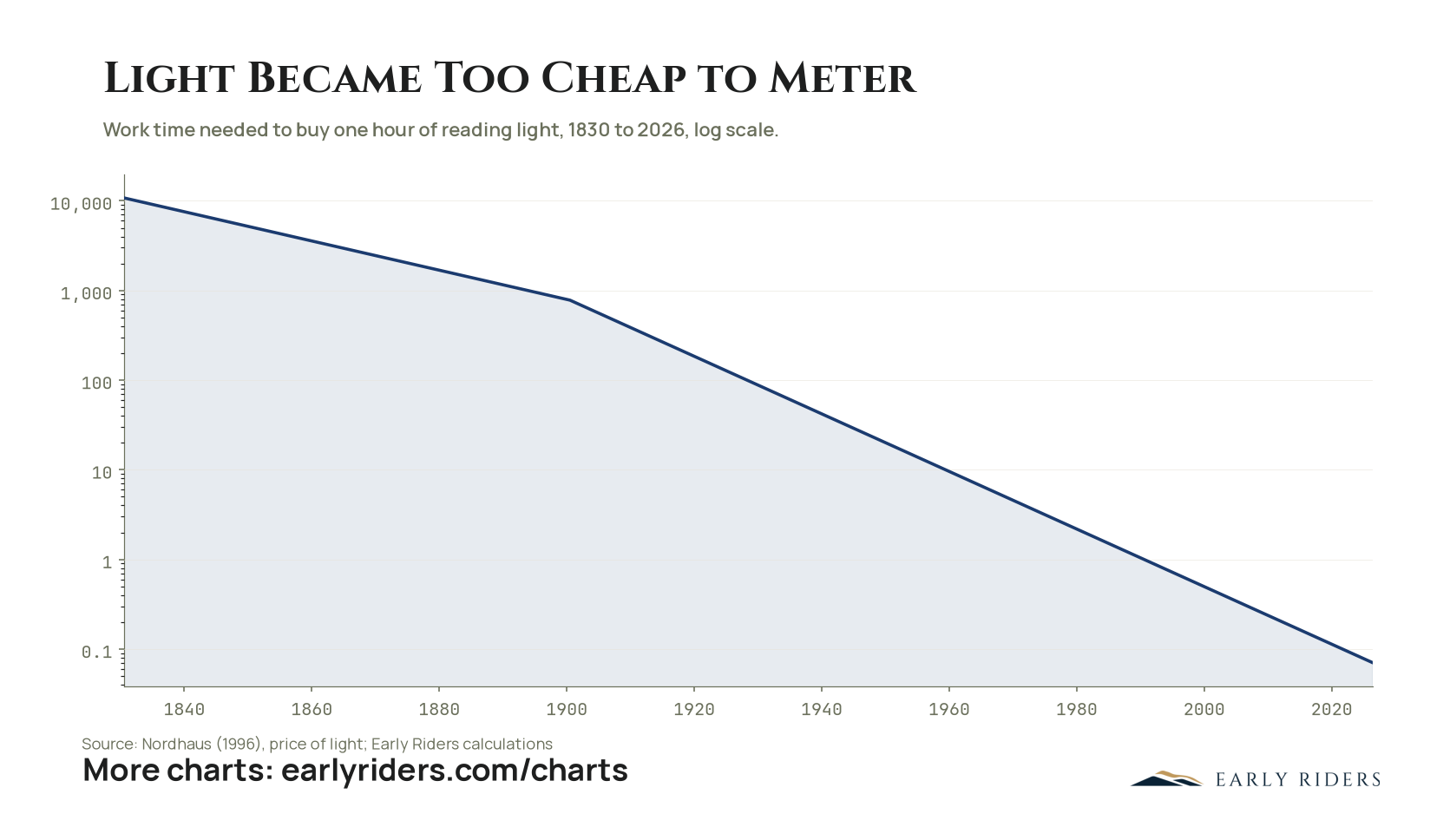
In 1830, an hour of decent reading light cost the average worker about three hours of labor.
18303hoursfor an hour of light
190013minutesfor the same hour
Today0.07secondstoo cheap to notice
For centuries illumination was a craft good, rendered from tallow by hand and consumed within hours of its making. Electrification made it a utility, generated in bulk and metered by the kilowatt hour, and the industries that were unthinkable in the candle era arrived as ordinary byproducts. The power grid accidentally led to the night shift, the modern hospital, and massive improvements in transportation and coordination 24/7.
Intelligence is undergoing a similar transition. For all of prior history, a unit of useful thinking cost a unit of human life, with the limiting factor as a brain that runs on a metabolic budget of roughly 20 watts. Artificial intelligence completes the sequence, because the thinking itself has become a manufactured good, produced in bulk and priced increasingly, in energy. And unlike light, intelligence improves the process that produces it, so every fall in its price reflexively drives the cost down, all else being equal.
ElectricityComputeIntelligenceWorkSettlement
Each layer is the physical input to the one above it, so a constraint anywhere reprices everything downstream, and an improvement anywhere compounds through the rest.Light became too cheap to meter. Intelligence is next.
Technological progress means doing more with less, and money is where the difference is saved. When the money supply expands, every gain in efficiency is met by new units bidding prices back up, and the useful work the energy performed is dissipated before anyone can hold it. Money with a fixed supply preserves the conversion, so efficiency arrives the way cheap light did, as rising purchasing power. We believe the gains of the singularity settle in money that costs energy to produce and cannot be expanded to absorb them, and this report is the argument for why.
Part II · The Framework
The Stack, Defined
The stack is a single conversion chain: electricity becomes compute, compute becomes intelligence, intelligence becomes work, and work becomes payments that need somewhere final to land. Each layer is the physical input to the one above it, so a constraint anywhere reprices everything downstream, and an improvement anywhere compounds through the rest.
Layer 01 · Energy
Layer 01 · Energy
Energy
Everything else in the stack, from tokens generated to transactions settled, resolves to electricity. The raw energy is there in abundance; the constraint is converting it and delivering it to where the demand sits.
Over 2,000GW of proposed generation waits in US interconnection queues, but delays and surprise upgrade costs mean most of it will be abandoned.
Intelligence applied to conversion, in better solar, storage, and reactors, makes electricity cheaper, and cheaper electricity makes intelligence cheaper in turn, the first step in the singularity.
Layer 02 · Compute
Compute
The compute behind frontier training runs has doubled roughly every six months, a compounding rate no prior buildout has approached.
Capability follows compute, with the length of tasks AI can complete doubling every four to seven months.
The acceleration is reflexive: this July a frontier model designed a working chip in a 48-hour run with no human intervention, a chip built to run a smaller version of the model that designed it.
Layer 03 · Models
Models
That same compounding destroys the business case, since every frontier model becomes the cheap commodity option within a year and open weight releases set the floor near zero.
Each generation now helps build the next, generating the training data, writing the training code, and teaching the smaller models that follow. Capability compounds on two axes, with compute scaling below and algorithmic progress cutting the price of a given intelligence level by roughly 10x a year.
The labs sit closer to the memory manufacturers than to the software companies they are valued like.
Layer 04 · Harnesses
Harnesses
So the switching cost in AI lives a layer above the model, and it deepens with use. The code itself is easy to copy, with open source implementations setting the floor price near zero, so the durable value sits in the operating context a harness accumulates: the memory, tools, credentials, evaluations, approvals, budgets, routing, and audit trails that build up around real work.
The effect is measurable, as identical weights that solved 2% of real software bugs in a chat window solved 6x as many inside an early harness that could read files and run tests.
Models underneath get swapped constantly on quality, cost, latency, and policy, and the harness is what makes those swaps routine, since nobody rebuilds that context every time.
Layer 05 · Agents
Agents
Work priced in tokens is work priced in electricity, and every layer below this one is driving that price toward zero.
Labor stops scaling with people at this layer, since one person can direct a dozen agents and an agent can spawn more when the task splits.
The work turns self-directed as well, because agents now build and test the layers beneath them.
Layer 06 · Identity
Identity
So identity inverts, from something granted from above to something the agent generates itself. On Nostr that is a keypair, a private key created in milliseconds with nobody's permission and a public key anyone can verify.
Company-issued accounts fail here twice, since agents multiplying by the billions overwhelm any issuer, and whatever an issuer grants it can revoke, erasing that graph along with the balance on one terms of service update.
The identity lives in the signatures on a decentralized network rather than on any server, so an agent banned from one relay reposts the same signed record elsewhere and loses nothing.
Layer 07 · Coordination
Coordination
The Model Context Protocol has become the default way to expose a system to a model, an open specification with no gatekeeper metering what flows through it.
The Agent2Agent specification lets agents built by different vendors delegate to one another, and delegation changes what capability means, since an agent that can hire specialists outperforms any single model working alone.
The shared workspace remains the unsolved third, since in Slack and Discord an agent is a bot account subject to the revocation problem above, while Buzz, an open source project from Block, makes humans and agents peers who each hold their own keys.
Layer 08 · Value Transfer
Value Transfer
Money has to move at the speed of the work it pays for, in tenth-of-a-cent amounts at the frequency of API calls, with finality in seconds because an agent cannot wait on a dispute process.
The card networks were built for none of this, since a fixed fee per authorization makes a micropayment cost more to process than the thing being bought, and settlement that takes days cannot serve work that finishes in seconds. What replaces them splits into rails, which move the money, and standards, which tell a machine how to ask for it.
Neither specification collects a toll, so the durable income goes to whoever issues the money the payments are made in.
Layer 09 · Settlement
Settlement
The singularity accelerates the buildout of everything except the money at the end of the stack: every other layer's scarcity gets competed away eventually, but Bitcoin's supply stays fixed no matter how much demand shows up.
So as the stack makes everything cheaper, whoever holds the fixed money watches their purchasing power rise.
The frame is the analytical tool: placing an event on its layer tells you how quickly supply can respond and where the value it creates will settle. A power contract and an agent payment standard sit seven layers apart but move the same variable, the cost of finished work, from opposite ends of the chain.
Part III · The Evidence
The acceleration is measurable
The singularity is best defined operationally, as a period in which the rate of improvement accelerates across enough independent domains that no single reading can be dismissed as hype.
Compute
4 to 5x
Frontier training compute growth
Epoch AI estimates that the computation used to train frontier AI models has been growing 4 to 5x per year, a doubling roughly every six months. Moore's law, the benchmark for relentless compounding across five decades, doubled every two years, and this buildout runs four times faster.
Adoption
2 months
ChatGPT to 100 million users
The telephone took roughly 75 years to reach 100 million users. ChatGPT reached 100 million monthly users in about two months. Even that record should fall, because the next wave of products will be adopted by agents as well as people, and agents adopt valuable tools as fast as they can read the specification.
Capital
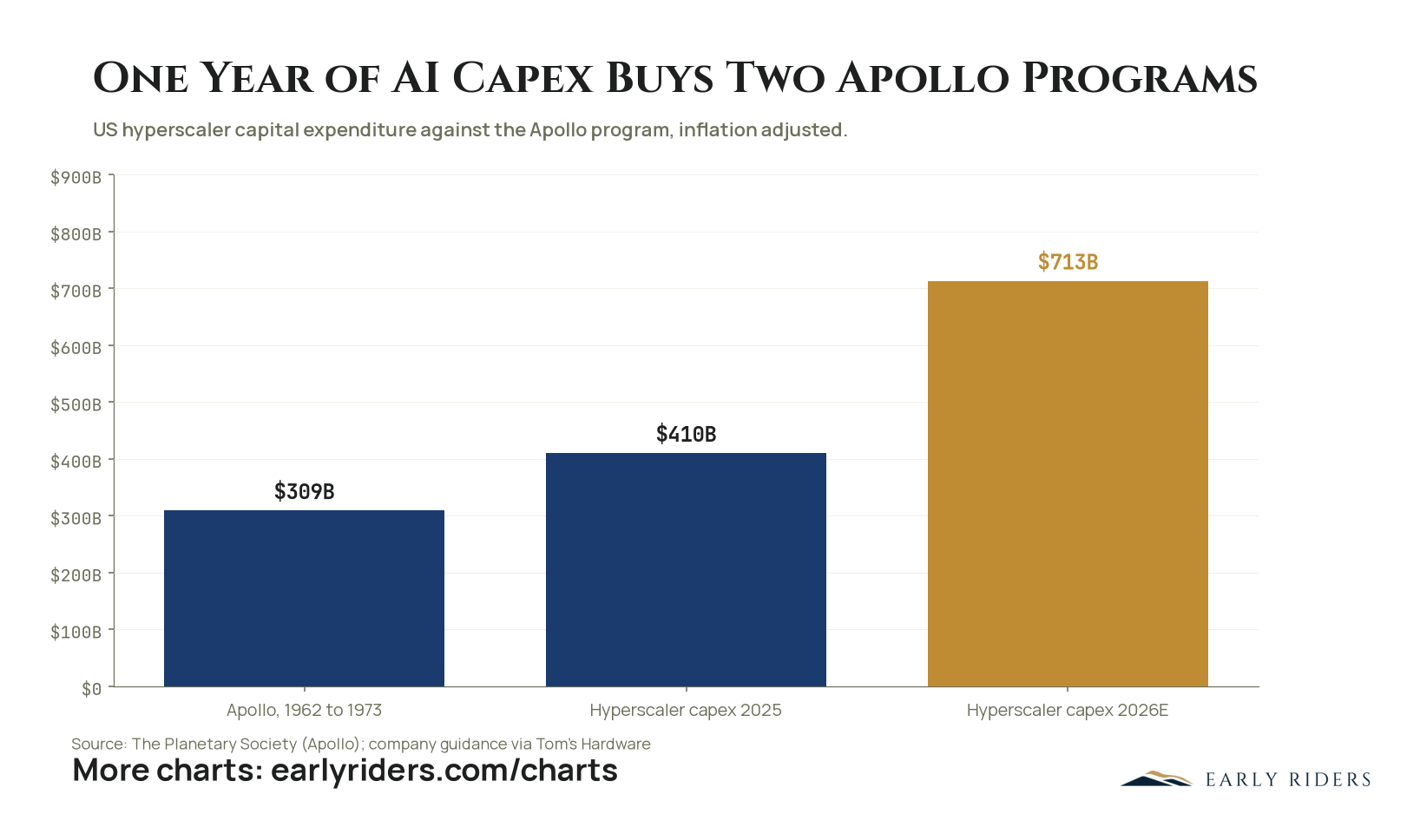
$713B
Hyperscaler capex planned for 2026
The entire thirteen-year Apollo program cost about $309 billion in today's dollars. The distinction from prior manias is the funding source, since the late 1990s fiber buildout was financed with debt by carriers that never earned it back, while this one is paid for out of the operating profits of the most profitable companies in history.
Energy
4-year
US electricity demand forecast
After two decades of essentially flat grid consumption, the EIA now forecasts the strongest four-year growth in US electricity demand since 2000, naming data centers alongside manufacturing onshoring and electrification as the drivers. A demand line that stayed flat through the entire smartphone and cloud era has bent, and it is not waiting for the grid.
Capability
12-hour
METR autonomous task horizon
METR measures the length of tasks AI systems complete autonomously at a 50% success rate. In 2019 the best model handled a task taking a human about two seconds. The doubling time has compressed from every seven months to roughly every four, and even at the stricter threshold the trend puts a full working week of unsupervised output inside a decade-long earnings forecast.
One year of planned AI capex buys more than two entire Apollo programs, in today's dollars.
Part IV · The Money
Deflation is the normal state
Productivity is exploding and life does not feel cheaper, for monetary reasons and not technological ones.
In the last three decades of the nineteenth century, under gold denominated money, the American price level drifted steadily lower while real output per person grew at a rate comparable to the strongest postwar decades. Mild deflation set a higher hurdle rate instead of paralyzing capital, and the country still laid track and built steel at a formidable pace.
Deflation is therefore the normal state of technological progress under a money nobody can expand at will. The modern reflex against it is institutional and not economic, since the Federal Reserve adopted its explicit 2% target only in January 2012.
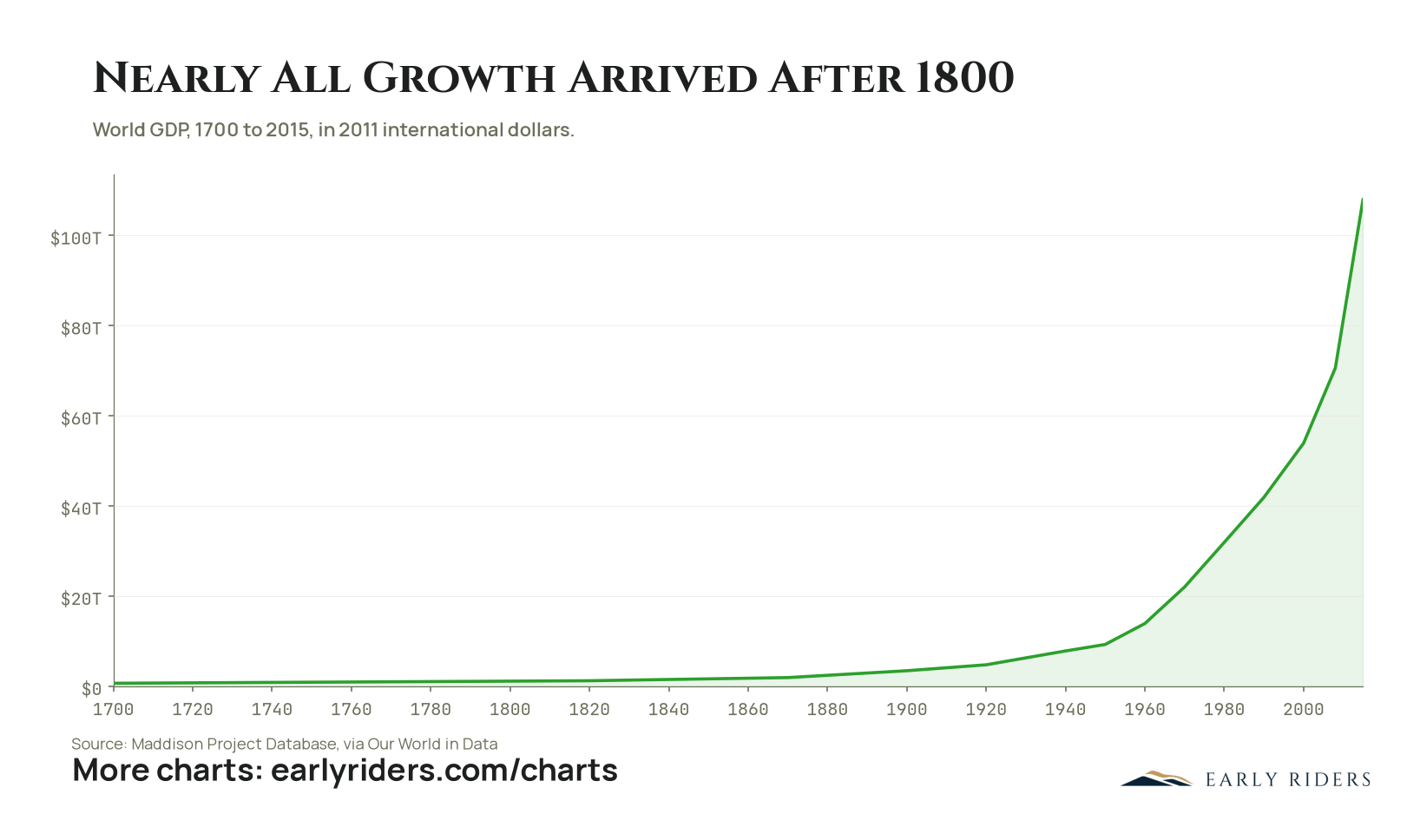
Nearly all growth arrived after 1800, and for much of that stretch prices drifted lower while output compounded.
The debt arithmetic
The System That Cannot Allow Deflation
In a debt based monetary order, falling prices are intolerable as a matter of arithmetic.
A loan is written in fixed nominal dollars, while the borrower's revenue is whatever prices the market will bear, so when technological deflation pushes down prices, the income shrinks and the principal does not. Irving Fisher set out the spiral in 1933, where borrowers default, banks pull credit, spending falls, and prices drop further, the sequence that failed roughly 9,000 US banks and contracted the money stock by a third between 1930 and 1933.
Every unit of technological deflation therefore has to be met with offsetting monetary expansion, and the singularity turns that from a maintenance task into a race.
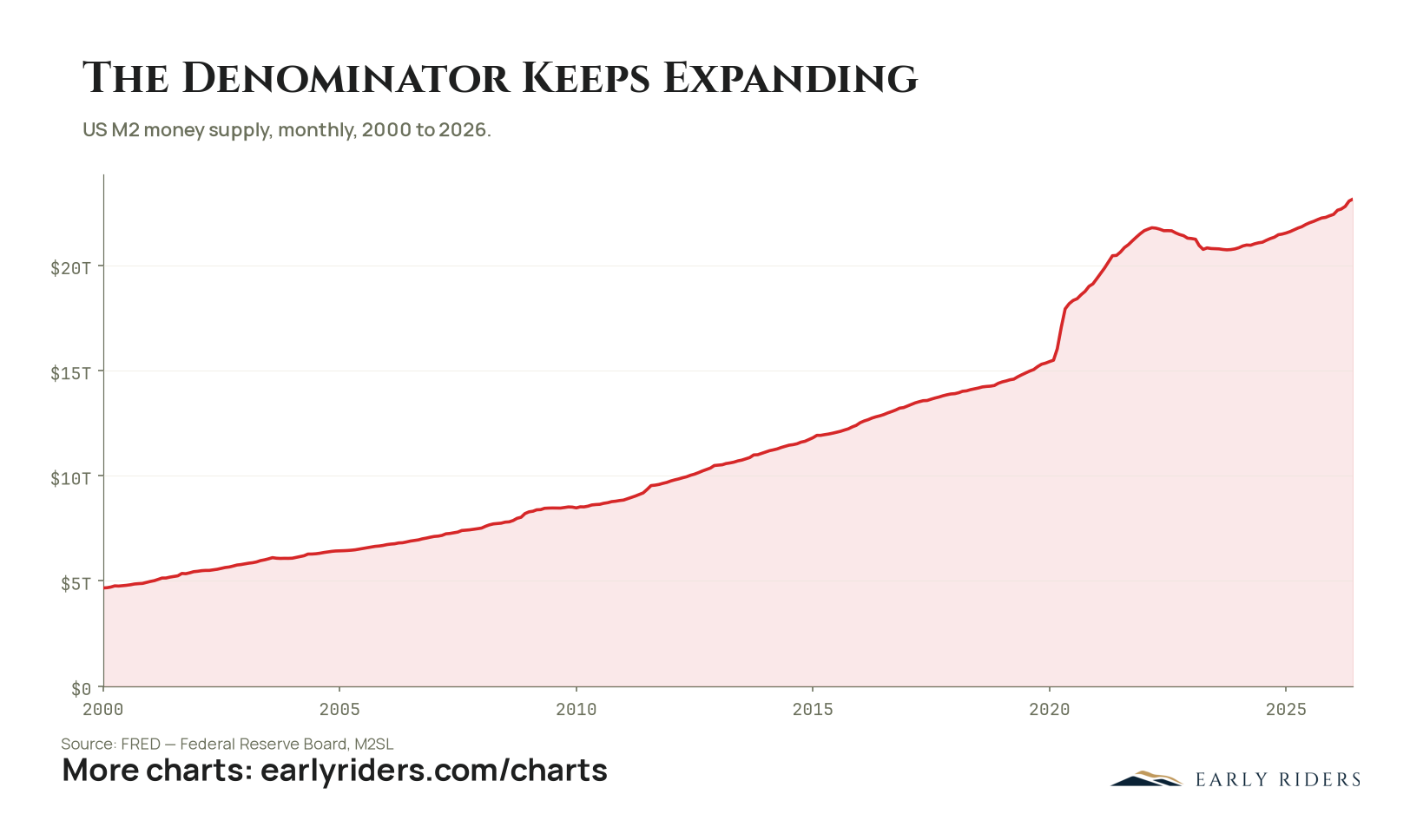
$4.7T
US M2, January 2000
$22T
US M2 today
$40T
Federal debt, interest above $1T
The denominator keeps expanding: $4.7T of M2 in January 2000 has become close to $22T today.
BLS component data, 2000 to today
The two economies
BLS component data shows the two economies side by side: everything manufactured and shippable, from televisions to software, has fallen steeply in price since 2000, while hospital services, tuition, childcare, and housing have outrun wages.
↓ Fell in price since 2000
Televisions
Software
Everything manufactured and shippable
↑ Outran wages
Hospital services
Tuition
Childcare
Housing
Technology delivers deflation in the reproducible half of life while monetary expansion lands in the scarce half, and the stack is aimed at moving the scarce half, priced mostly in trained human time, into the reproducible column.
The collision
The deflationary force now arriving is aimed directly at labor, since agents convert capability into completed work that used to require a salary, and trained human time is the dominant cost in everything that has grown more expensive for decades. The monetary system has to answer with expansion large enough to keep $40 trillion of federal debt serviceable, stretching the unit of account to absorb an exponential.
Most households, whose wealth sits in wages and deposits, risk living through the largest productivity boom on record as a cost of living squeeze.
Part V · The Position
The Purest Expression Of The Singularity
The singularity does not float free of the physical world, because a model cannot immediately generate the electricity it consumes.
What the machine still has to buy
Somebody has to sign a twenty year power purchase agreement promising megawatt hours in 2046 at a price written in 2026. The faster the machine improves, the more its future hangs on the slowest instruments in the economy, contracts that only work if the money holds.
Under expandable money, being close to the newly created supply wins, which is how a company burning cash outbids a profitable manufacturer for power. Under fixed money, only output that customers actually pay for wins.
Participation
There is no direct way to own the singularity, but every layer of the stack can be owned somewhere, and there is money to be made in each. The difficulty is that every one of those positions adds a way to be right about the acceleration and wrong about the outcome, since a layer bet has to name the winner before competition arrives.
In our view Bitcoin is the purest expression of the singularity stack, and the position with the fewest ways to lose. Every conversion from energy through to finished work settles in money at the end, so holding the settlement asset claims a share without naming the layer or the company that books the margin. It carries no earnings to miss and no shares to dilute, and no competitor can ship a better version of a fixed supply.
On-chain estimates put roughly half of Bitcoin's supply dormant for more than a year, so rising demand competes for the fraction actually available.
Who keeps the gains
Intelligence priced near the electricity behind it means expert help in medicine, law, engineering, and education for roughly the cost of light, and the surplus reaches people who never touch a model.
The industrial era already ran this experiment under a money nobody could print: an ordinary saver who simply held gold backed money watched railroads and cheap steel arrive as rising purchasing power. That transition is running again, at the singularity's pace.
The cost of intelligence keeps falling toward the cost of electricity, and everyone will share in what that intelligence can do.
Bitcoin captures the gains directly, while in dollar terms they are inflated away.
A differentiated business at any layer, one whose advantage survives the arrival of new supply, keeps its margin through the transition. Larger businesses can now be built with less capital and fewer people than at any point in history, since labor that once required headcount is provisioned by the token, so the returns to a real edge have never been higher. Early Riders invests in both.